SIX
See It Work · Book 01 · AI Agents for CFOs · Chapter 4
Month-end close in four hours, not three days
The profit-and-loss statement is fundamental and, in most companies, the most painful report to produce — month-end close, journal adjustments, reconciliation. A P&L automation agent does that mechanical assembly. The close drops from three days to about four hours, and your judgment on the numbers stays exactly where it was.
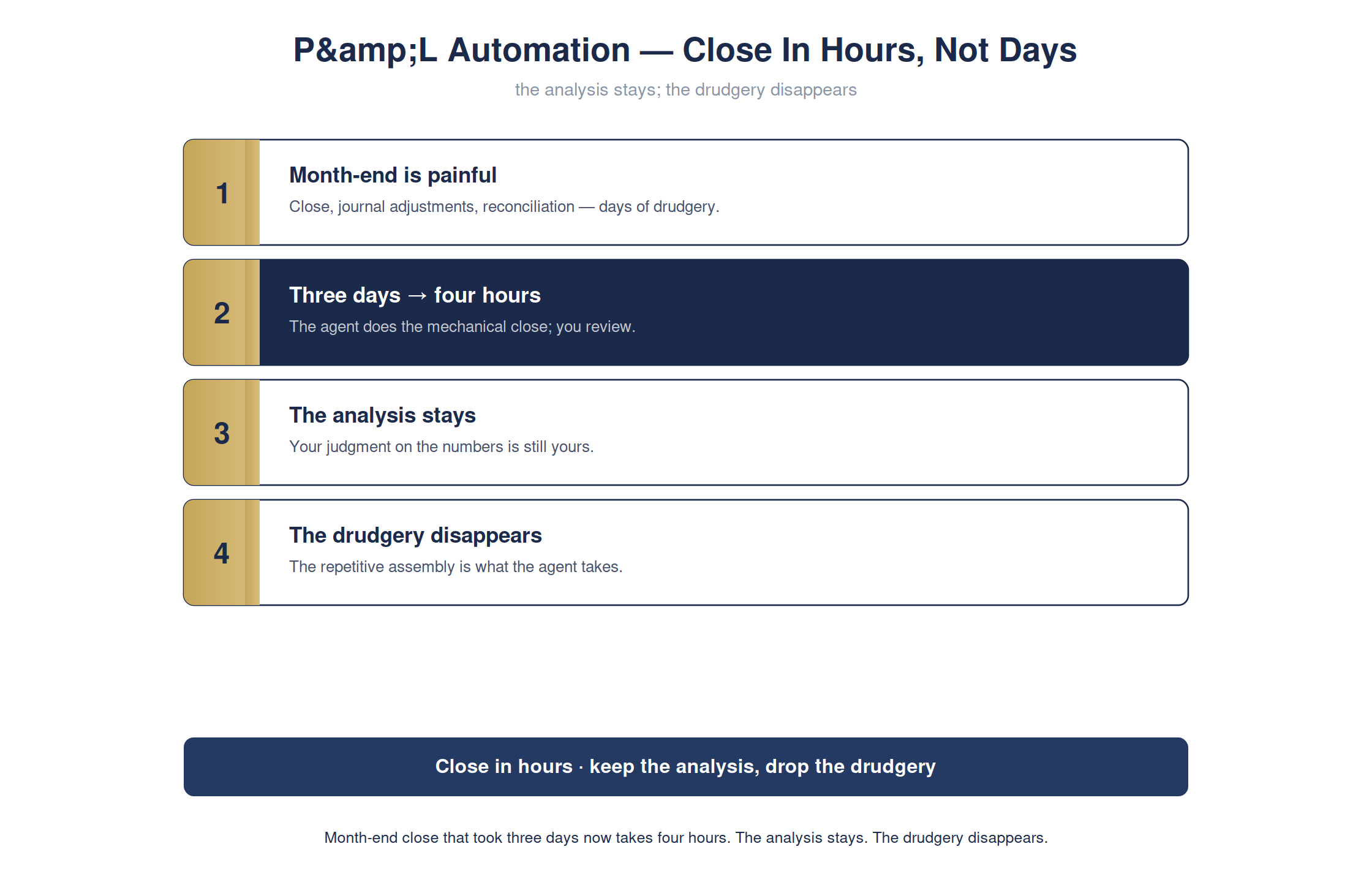
The full detailed chart. Condensed for print legibility in the book; shown here at full size.
Every month, your team burns days on the mechanical close instead of analyzing what the numbers mean. Automate the assembly and they get those days back for the analysis that matters.
CFO's desk · month-end closeready
The mechanical close compresses; the analysis is untouched:
P&L Automation
month-end close3 days → 4 hours
journal adjustmentsautomated
the analysisstays yours
the drudgerydisappears
Month-end close that took three days now takes four hours. The analysis stays. The drudgery disappears.
For the technical reader — the command, and how to verify it yourself
# one line · you do not need to run this
see walkthrough
see walkthrough
see walkthrough
# -> a month-end close in four hours with the analysis kept human
# -> a month-end close in four hours with the analysis kept human
Full step-by-step is in Appendix RX: Hands-On Demonstrations in the book.