SIX
See It Work · Book 01 · AI Agents for CFOs · Chapter 6
Catch the overspend as it happens — not at month-end
Traditional variance analysis is a month-end post-mortem: by the time you see the overspend, it already happened and the chance to stop it is gone. A real-time variance agent flags the divergence the moment it appears, so you correct course while it still matters — worth a reported $250K-$1M a year.
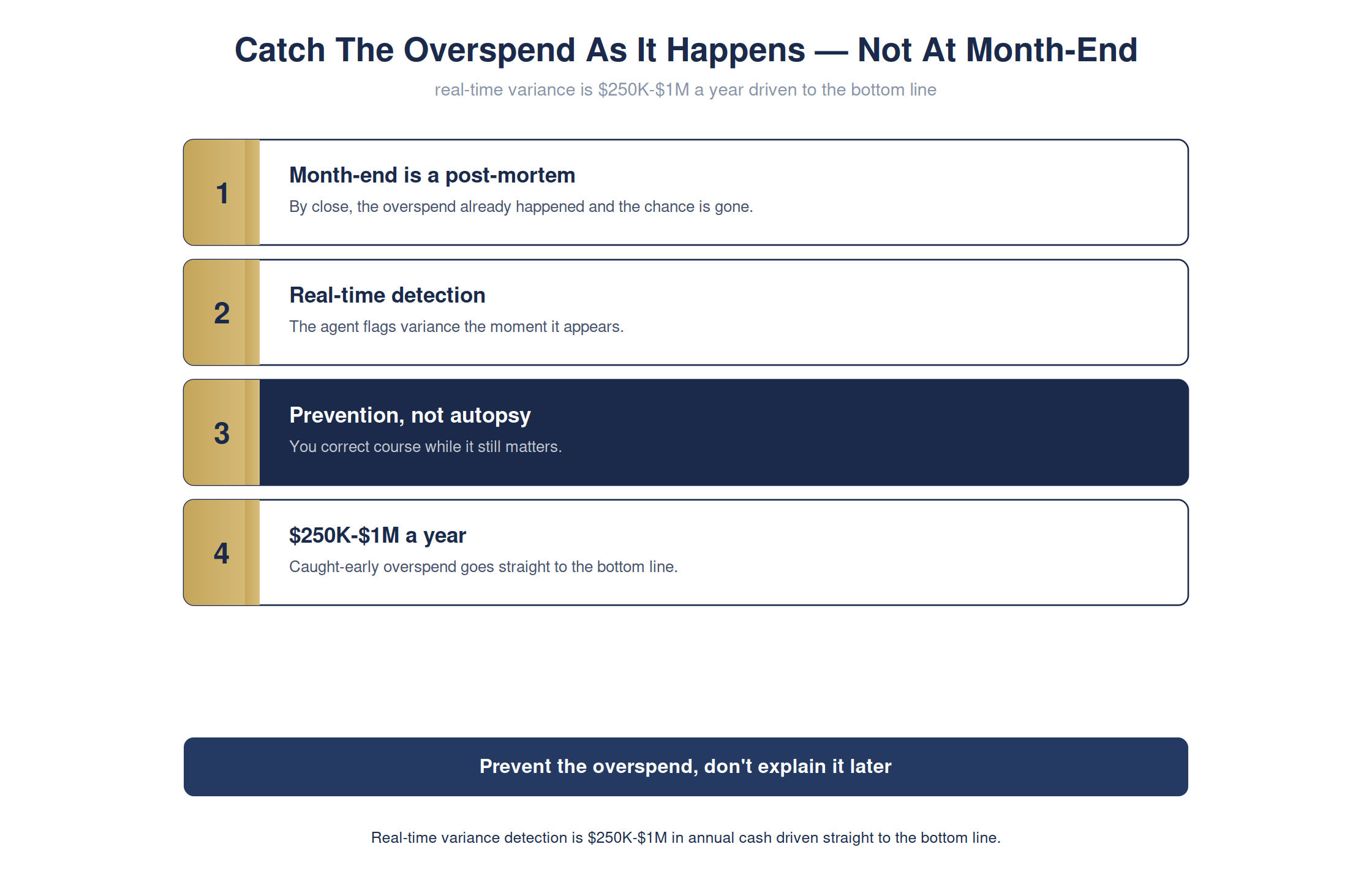
The full detailed chart. Condensed for print legibility in the book; shown here at full size.
The difference between catching an overspend in real time and explaining it at month-end is the difference between prevention and an autopsy — and, across a year, real money to the bottom line.
CFO's desk · budget varianceready
Variance surfaces in real time — prevention, not a post-mortem:
Real-Time Variance
traditionalmonth-end post-mortem
agentflags it as it happens
resultprevention, not autopsy
value$250K-$1M / year
Real-time variance detection is $250K-$1M in annual cash driven straight to the bottom line.
For the technical reader — the command, and how to verify it yourself
# one line · you do not need to run this
see walkthrough
see walkthrough
see walkthrough
# -> an overspend flagged as it happens, not explained at month-end
# -> an overspend flagged as it happens, not explained at month-end
Full step-by-step is in Appendix RX: Hands-On Demonstrations in the book.