SIX
See It Work · Book 02 · AI Agents for Executive Decisions · Chapter 10
Agent confidence is not agent accuracy
These are real failure patterns. The core lesson: agent confidence and agent accuracy are different things. An agent produces a polished, authoritative-sounding analysis — and if it's built on stale data, that's worse than no analysis at all, because its confidence earns trust the data doesn't deserve.
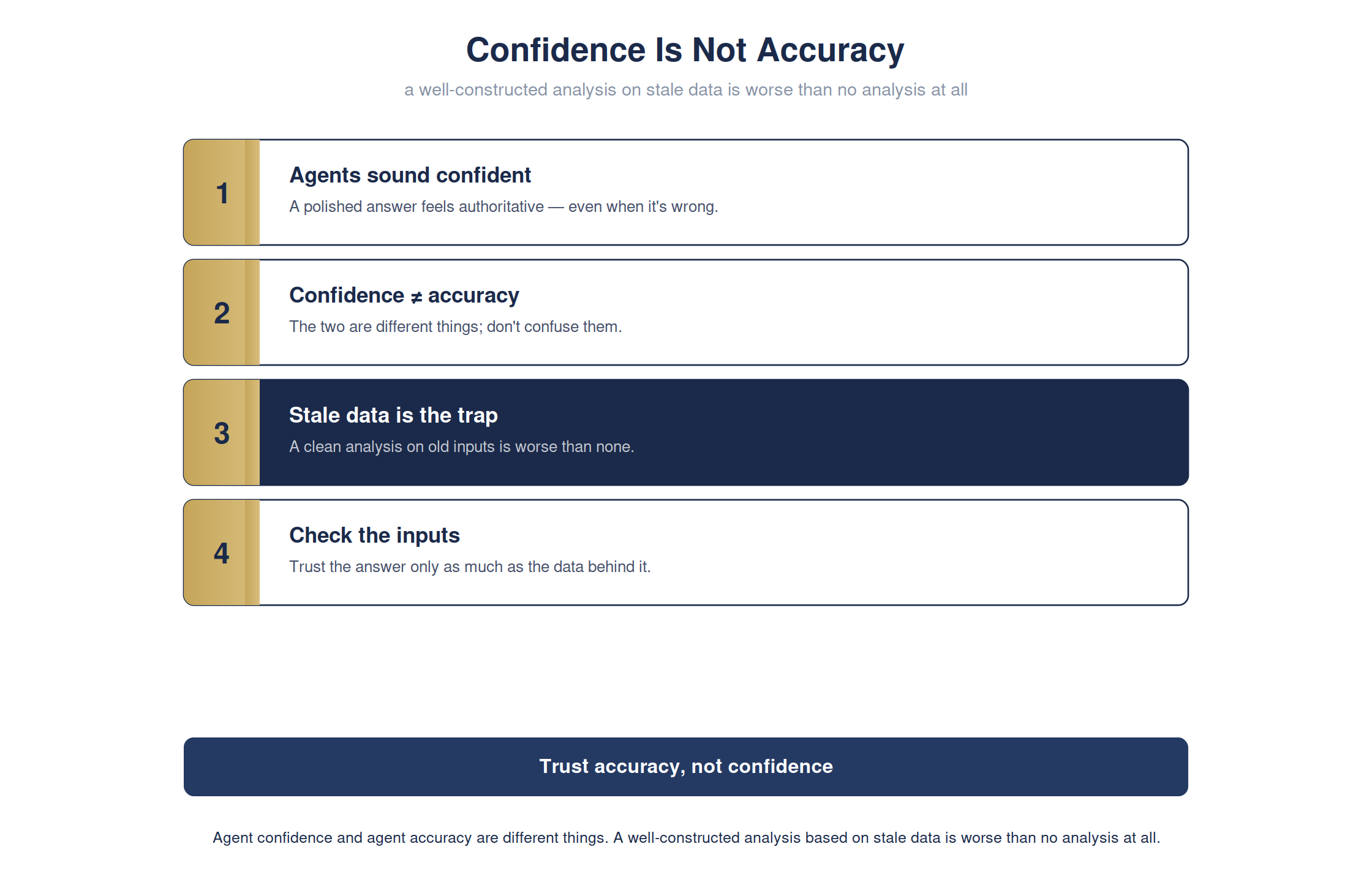
The full detailed chart. Condensed for print legibility in the book; shown here at full size.
The danger isn't an agent that's uncertain — it's an agent that's confidently wrong on old inputs, because that's the one that gets believed and acted on.
Executive desk · failure post-mortemsready
The failure mode is confidence outrunning accuracy:
When Agents Fail
agentssound confident
confidenceis not accuracy
stale data + polishworse than no analysis
the guardcheck the inputs
Agent confidence and agent accuracy are different things. A well-constructed analysis based on stale data is worse than no analysis at all.
For the technical reader — the command, and how to verify it yourself
# one line · you do not need to run this
see walkthrough
see walkthrough
see walkthrough
# -> the confident-but-wrong failure mode and how to guard against it
# -> the confident-but-wrong failure mode and how to guard against it
Full step-by-step is in Appendix RX: Hands-On Demonstrations in the book.