SIX
See It Work · Book 02 · AI Agents for Executive Decisions · Chapter 5
Ninety percent of agent failures are context failures
When a decision agent disappoints, the instinct is to blame the model. Usually wrong: ninety percent of agent failures are context failures, not model failures. The same model produces radically different output depending on what you feed it — so the real skill, context engineering, is getting the inputs right.
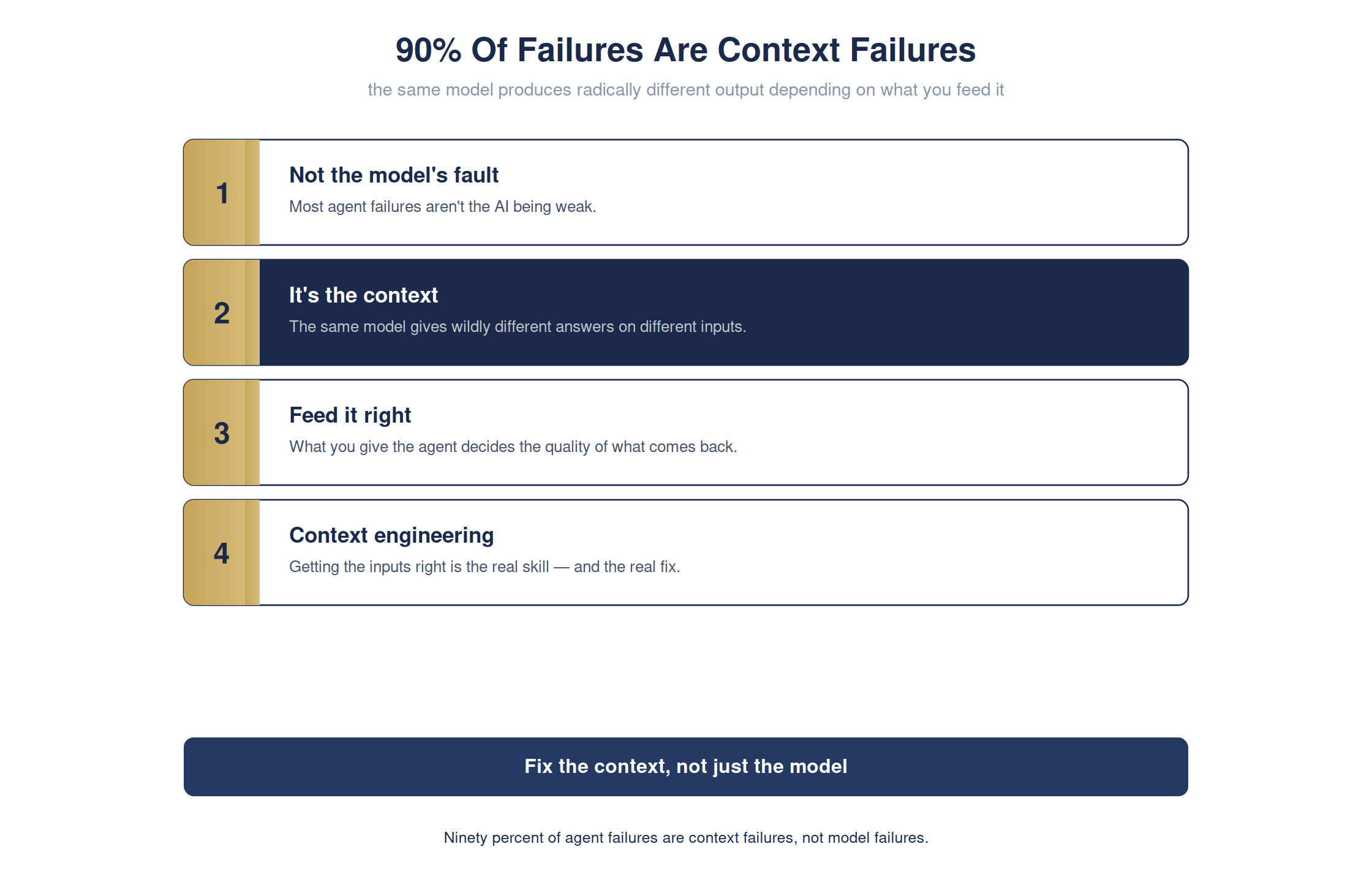
The full detailed chart. Condensed for print legibility in the book; shown here at full size.
Chase a 'better model' and you fix the wrong thing. Fix the context — what the agent is given — and the same model suddenly performs, because the inputs were the problem all along.
Executive desk · context engineeringready
The failure is in the inputs, not the model:
Context Engineering
blamedthe model
actuallythe context
same modeldifferent context → different output
the skillget the inputs right
Ninety percent of agent failures are context failures, not model failures.
For the technical reader — the command, and how to verify it yourself
# one line · you do not need to run this
see walkthrough
see walkthrough
see walkthrough
# -> the same model performing once the context is engineered right
# -> the same model performing once the context is engineered right
Full step-by-step is in Appendix RX: Hands-On Demonstrations in the book.