SIX
See It Work · Book 02 · AI Agents for Executive Decisions · Chapter 7
The agent sees the numbers; you see the humans
The human-agent decision loop has a clean boundary. The agent sees the numbers — the data, the analysis, the options. You see the humans — the morale, the relationships, the politics, the timing that no dataset captures. That boundary is precisely where executive judgment earns its keep.
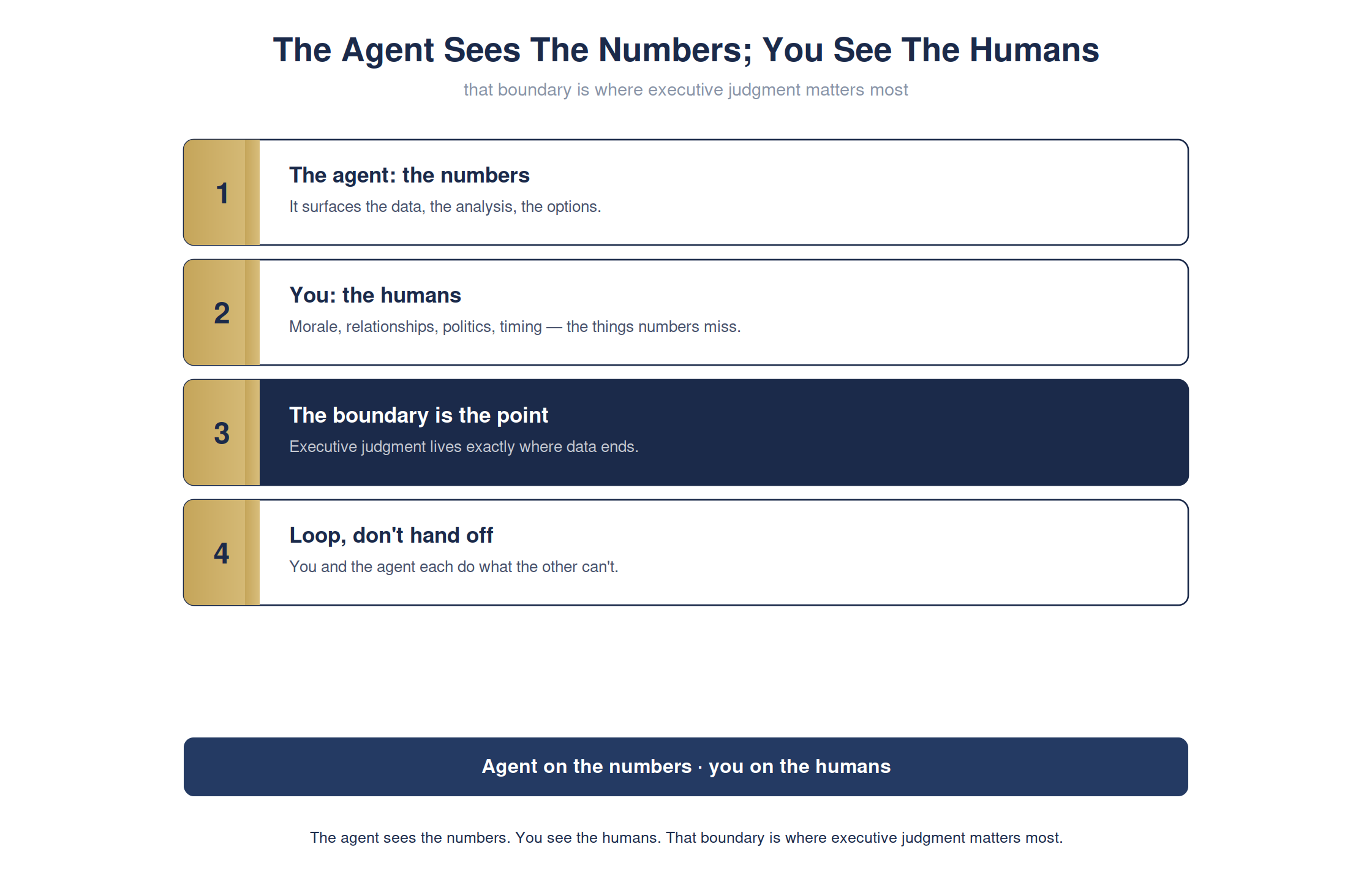
The full detailed chart. Condensed for print legibility in the book; shown here at full size.
Hand the whole decision to the agent and you lose the human read that decides whether a numerically-right move actually works. Keep the loop and each side does what the other can't.
Executive desk · the decision loopready
The boundary between agent and executive is the numbers/humans line:
Human-Agent Loop
the agentsees the numbers
yousee the humans
the boundarywhere judgment matters most
the loopeach does what the other can't
The agent sees the numbers. You see the humans. That boundary is where executive judgment matters most.
For the technical reader — the command, and how to verify it yourself
# one line · you do not need to run this
see walkthrough
see walkthrough
see walkthrough
# -> the agent on the numbers and the executive on the humans
# -> the agent on the numbers and the executive on the humans
Full step-by-step is in Appendix RX: Hands-On Demonstrations in the book.