SIX
See It Work · Book 03 · Leading AI Agents · Chapter 3
Capability is the agent's; accountability is always a human's
It's tempting to divide human-vs-agent roles by capability — give the agent whatever it can do. Wrong axis. The real division is accountability: an agent might be fully capable of a task, but a human still owns the result. Capability is the agent's; accountability stays human, always.
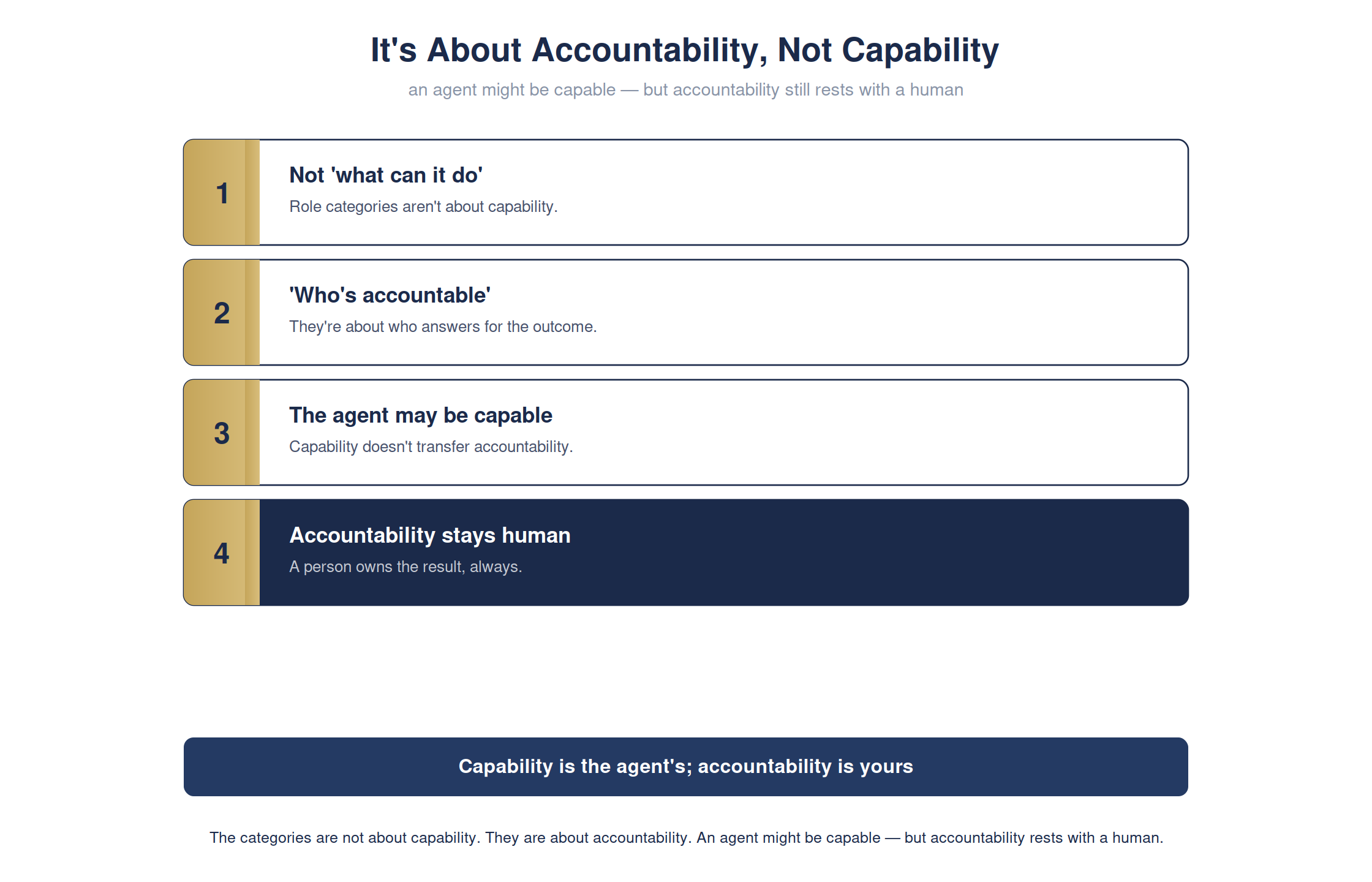
The full detailed chart. Condensed for print legibility in the book; shown here at full size.
Confuse capability with accountability and you end up with outcomes no one owns — the exact gap where things go wrong and no one's responsible. Anchoring accountability to a human closes it.
Leading agents · roles & accountabilityready
The dividing line is accountability, not capability:
Role Definition
not aboutcapability
aboutaccountability
the agentmay be capable
a humanowns the outcome
The categories are not about capability. They are about accountability. An agent might be capable — but accountability rests with a human.
For the technical reader — the command, and how to verify it yourself
# one line · you do not need to run this
see walkthrough
see walkthrough
see walkthrough
# -> work divided by accountability, with a human owning every outcome
# -> work divided by accountability, with a human owning every outcome
Full step-by-step is in Appendix RX: Hands-On Demonstrations in the book.