SIX
See It Work · Book 04 · AI Agents for Supply Chain · Chapter 1
The $15M response gap — why speed beats planning
Most supply chains respond to disruption in weeks, not days — and that lag costs three to five percent of annual revenue. For a $500M manufacturer, that's a $15M response gap. The shift this book makes: speed beats planning. A fast, good-enough response inside the window beats a perfect plan that arrives after it.
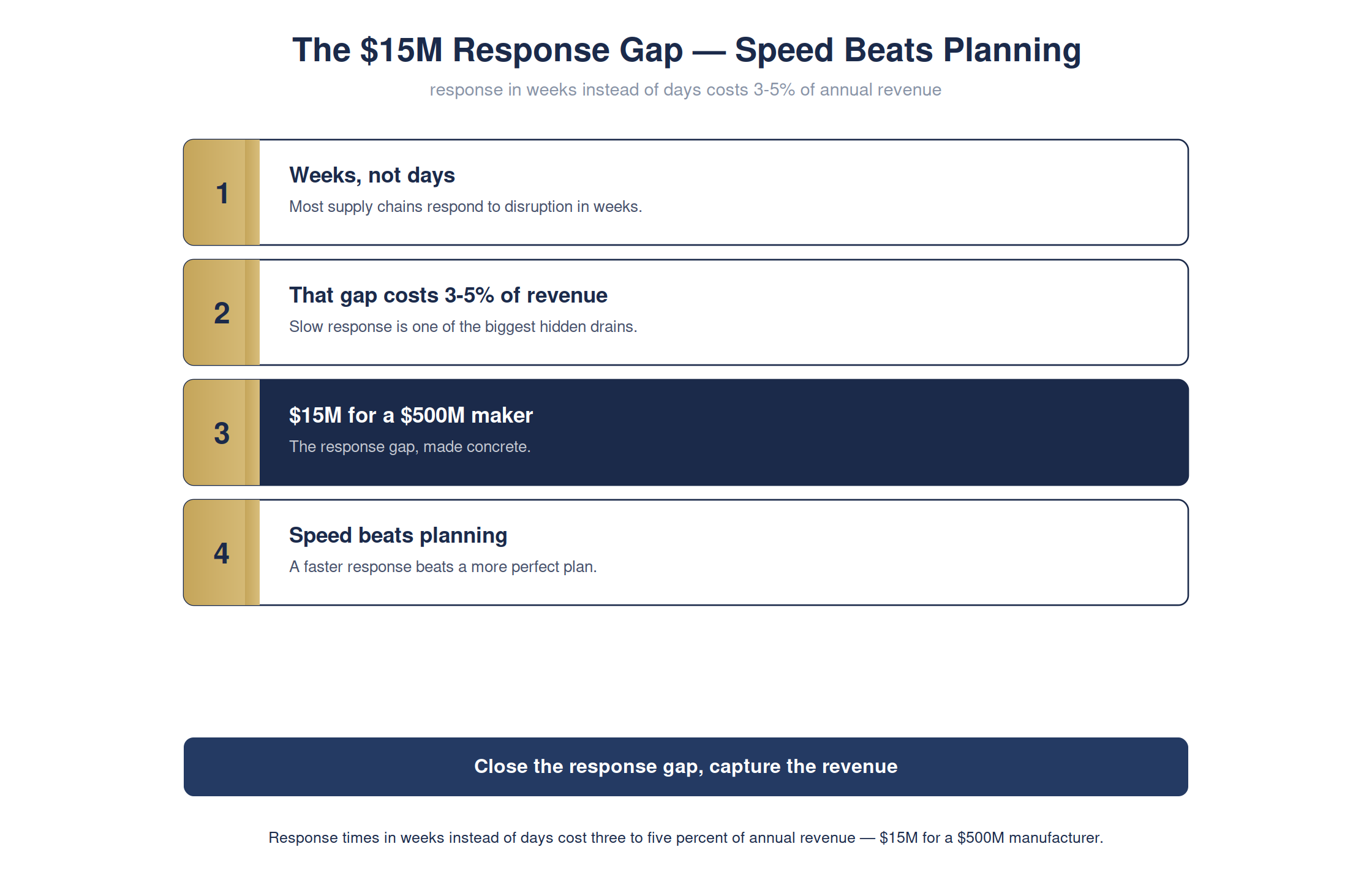
The full detailed chart. Condensed for print legibility in the book; shown here at full size.
The response gap doesn't show up as a line item — it's revenue lost to disruptions you reacted to too slowly. Closing it is one of the largest uncaptured gains in operations.
Operations · the response gapready
The response gap is real revenue lost to slow reaction:
The Response Gap
response timeweeks, not days
cost3-5% of annual revenue
$500M maker$15M gap
the shiftspeed beats planning
Response times in weeks instead of days cost 3-5% of annual revenue — $15M for a $500M manufacturer.
For the technical reader — the command, and how to verify it yourself
# one line · you do not need to run this
see walkthrough
see walkthrough
see walkthrough
# -> the $15M cost of a weeks-long response, and why speed wins
# -> the $15M cost of a weeks-long response, and why speed wins
Full step-by-step is in Appendix RX: Hands-On Demonstrations in the book.