SIX
See It Work · Book 05 · AI Agents for HR & Talent · Chapter 7
The $380K mistake — fix pay equity as a system, not one gap
Pay equity has a trap: fix one visible gap and it cascades — adjusting one person's pay puts others out of line, and the corrections ripple. A partial fix cost $380K in cascading adjustments. A pay-equity agent models the whole system, not just the one gap, so a fix resolves the inequity instead of spawning new ones.
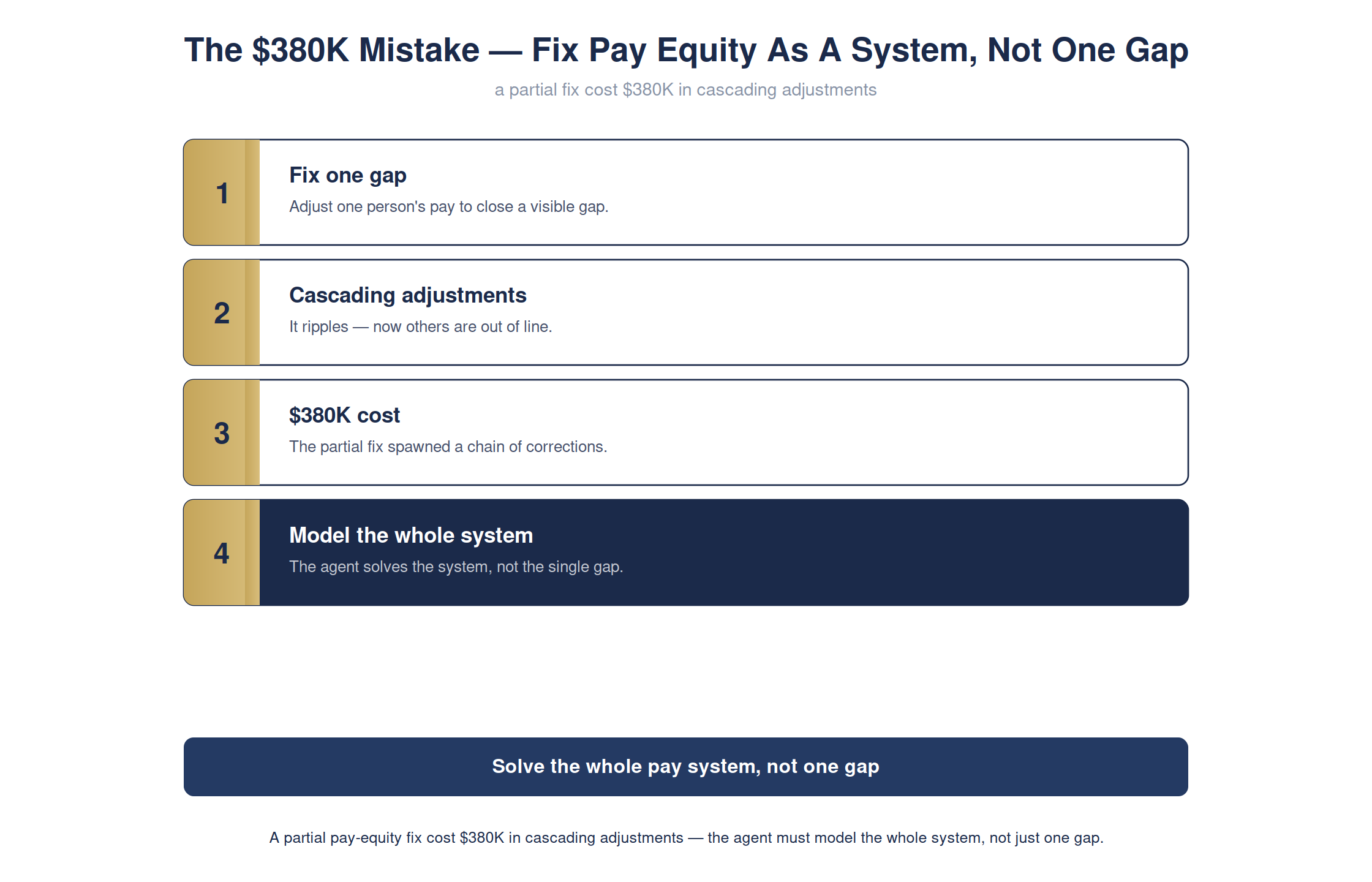
The full detailed chart. Condensed for print legibility in the book; shown here at full size.
Compensation is a system, not a list of independent numbers. Touch one without modeling the whole and you create the next inequity — which is how a well-meant fix becomes a $380K chain reaction.
CHRO's desk · pay equityready
Compensation is solved as a system, avoiding the cascade:
Pay Equity
fix one gapin isolation
resultcascading adjustments
cost$380K
the fixmodel the whole system
A partial pay-equity fix cost $380K in cascading adjustments — the agent must model the whole system, not just one gap.
For the technical reader — the command, and how to verify it yourself
# one line · you do not need to run this
see walkthrough
see walkthrough
see walkthrough
# -> pay equity solved as a whole system, avoiding the $380K cascade
# -> pay equity solved as a whole system, avoiding the $380K cascade
Full step-by-step is in Appendix RX: Hands-On Demonstrations in the book.