SIX
See It Work · Book 09 · Building Multi-Agent Teams · Chapter 2
The pattern you choose decides how everything behaves
Multi-agent systems come in patterns: orchestrator (one manager coordinates), hierarchical (layered authority), swarm (many peers, emergent coordination). The choice isn't cosmetic — the pattern you choose determines how agents communicate, who has authority, and how failures cascade. Pick it deliberately, because it shapes everything built on top.
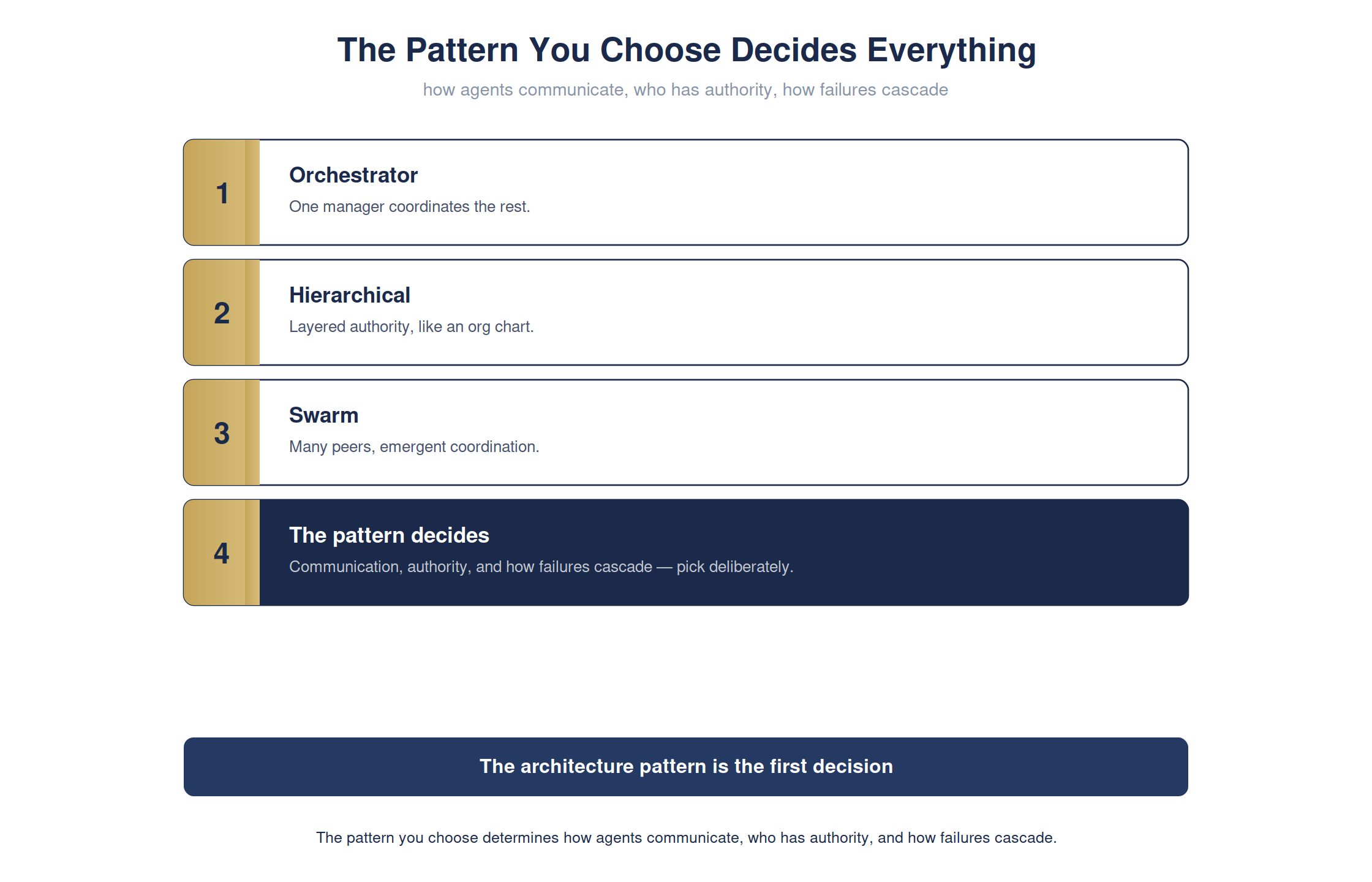
The full detailed chart. Condensed for print legibility in the book; shown here at full size.
Choose the pattern by default and you inherit its failure modes by surprise. Choosing deliberately means you've decided in advance how authority flows and how a failure is contained — before it's tested in production.
Architecture desk · patternsready
The pattern shapes communication, authority, and failure behavior:
Architecture Patterns
orchestratorone manager coordinates
hierarchicallayered authority
swarmemergent peer coordination
the patterndecides how failures cascade
The pattern you choose determines how agents communicate, who has authority, and how failures cascade.
For the technical reader — the command, and how to verify it yourself
# one line · you do not need to run this
see walkthrough
see walkthrough
see walkthrough
# -> the architecture pattern that decides communication, authority, and failure
# -> the architecture pattern that decides communication, authority, and failure
Full step-by-step is in Appendix RX: Hands-On Demonstrations in the book.