SIX
See It Work · Book 09 · Building Multi-Agent Teams · Chapter 5
Free-form agent chatter wastes tokens and corrupts state
How agents talk matters as much as what they do. Ambiguous free-form messages between agents waste tokens and corrupt state — loose prose is expensive to process and its ambiguity compounds into wrong shared state. The fix is structured communication protocols and shared memory: defined message formats and a clean shared store, so the team's reasoning stays correct as it scales.
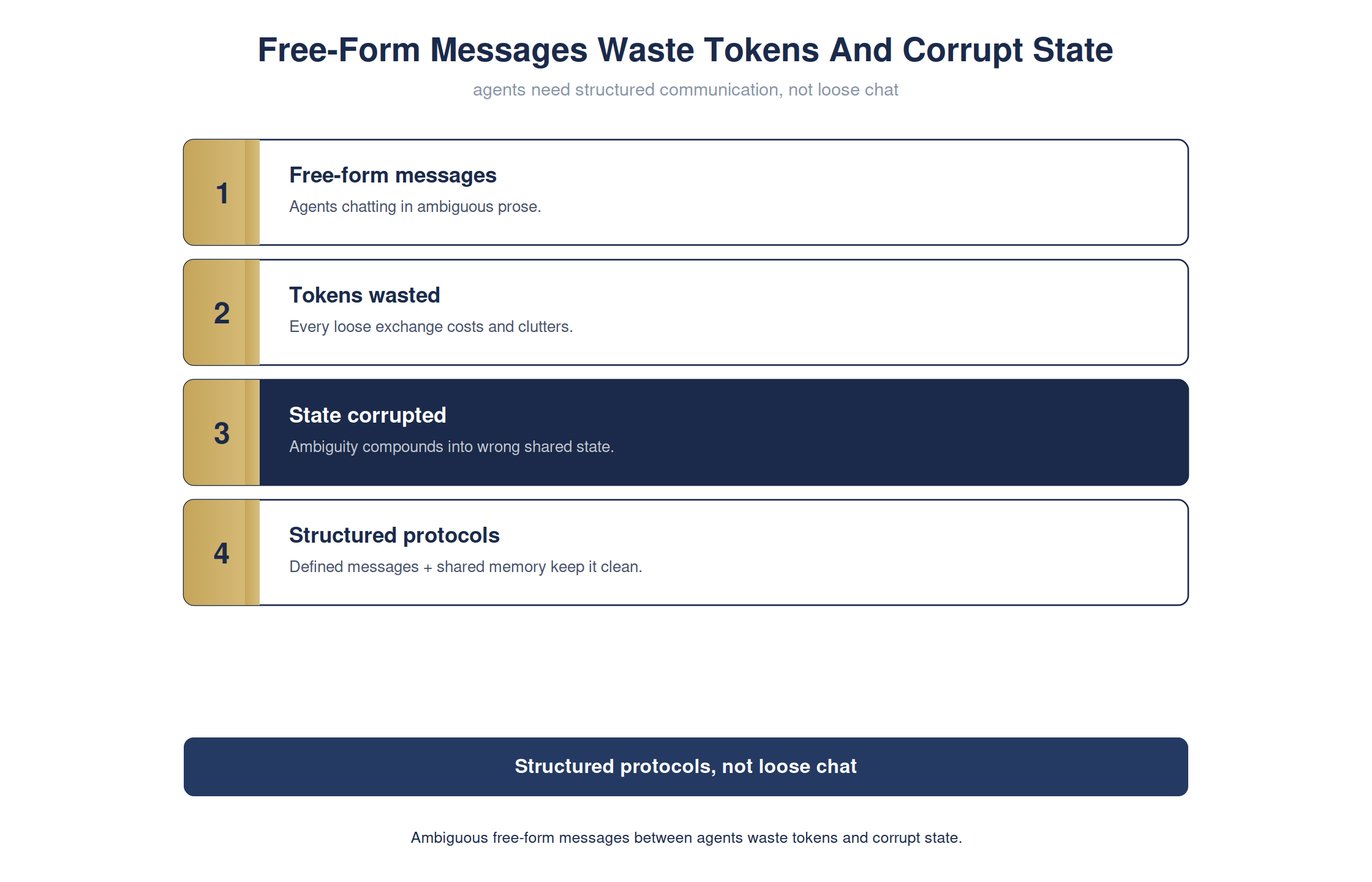
The full detailed chart. Condensed for print legibility in the book; shown here at full size.
Free-form chatter between agents is a hidden tax and a correctness risk — every ambiguous exchange costs tokens and can poison what the team believes is true. Structured protocols eliminate both.
Architecture desk · communication protocolsready
Structured protocols replace costly, state-corrupting chatter:
Communication Protocols
free-form messagesambiguous prose
costwasted tokens
riskcorrupted state
the fixstructured protocols + shared memory
Ambiguous free-form messages between agents waste tokens and corrupt state.
For the technical reader — the command, and how to verify it yourself
# one line · you do not need to run this
see walkthrough
see walkthrough
see walkthrough
# -> structured protocols and shared memory keeping the team's state correct
# -> structured protocols and shared memory keeping the team's state correct
Full step-by-step is in Appendix RX: Hands-On Demonstrations in the book.