SIX
See It Work · Book 10 · Scaling AI Agents · Chapter 10
When scaling fails — and how to make sure it doesn't
These are real patterns from enterprise agent rollouts (names illustrative, failures authentic). Cost overruns from no spend caps. Security incidents from no access control. Stalled initiatives from no maturity path. Each is prevented by a structural fix — hard caps, zero-trust, and a clear stage-by-stage plan — applied before the rollout, not after.
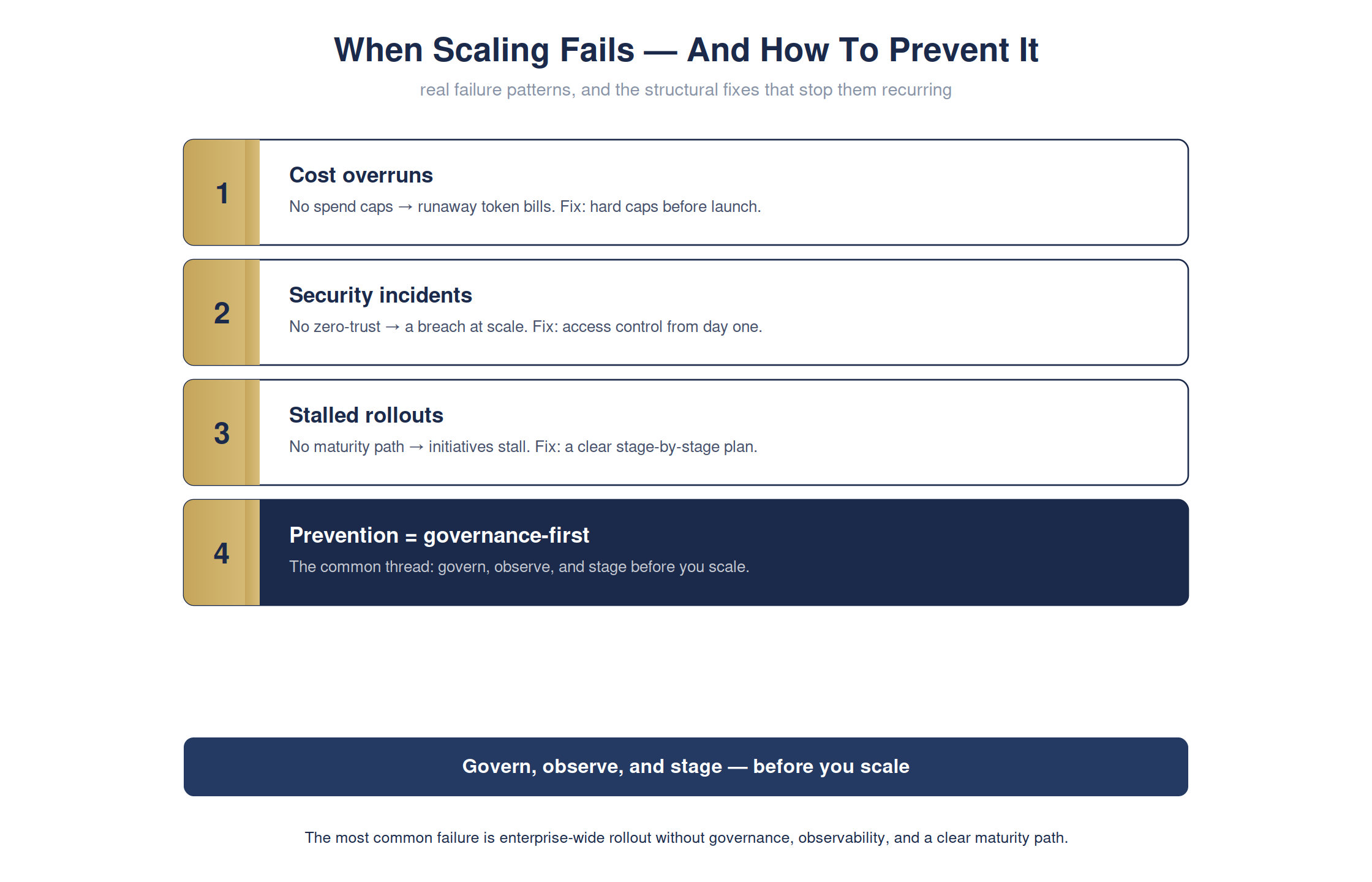
The full detailed chart. Condensed for print legibility in the book; shown here at full size.
The most common failure mode is attempting an enterprise-wide rollout without first establishing governance, observability, and a maturity path — leading to cost overruns, security incidents, and stalled programs. The fix is order: govern, observe, and stage before you scale.
Platform Console · failure post-mortemsready
The common failure patterns each map to a structural, pre-launch fix:
When Scaling Fails
cost overrunsfix: hard caps before launch
security incidentsfix: zero-trust from day one
stalled rolloutsfix: a clear maturity path
common threadgovern + stage before scale
The most common failure is scaling without governance, observability, and a maturity path first.
For the technical reader — the command, and how to verify it yourself
# one line · you do not need to run this
see walkthrough
see walkthrough
see walkthrough
# -> the failure patterns and their structural, pre-launch fixes
# -> the failure patterns and their structural, pre-launch fixes
Full step-by-step is in Appendix RX: Hands-On Demonstrations in the book.