SIX
See It Work · S2 Vol 1 · Sovereign Inference & Memory · Chapter 7
Try to break it — and watch it hold
A determined attacker has three angles: fake a seal (forge the tamper-proof signature), mislabel sensitive data (sneak RED past as YELLOW so it can leave), or corrupt the memory filter (trick it into hiding something). Each one is stopped by the design itself, not by you remembering to check.
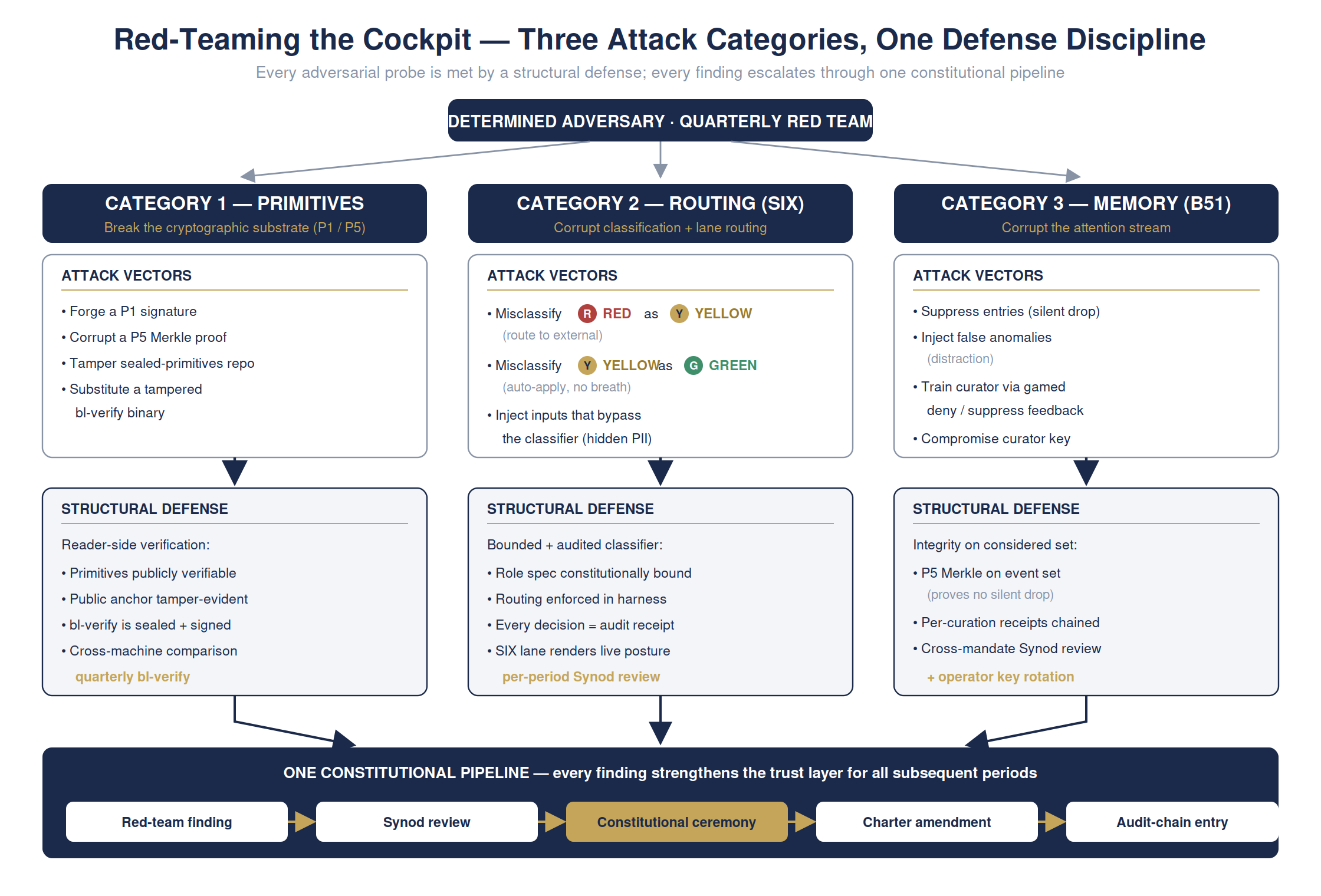
The full detailed chart. Condensed for print legibility in the book; shown here at full size.
The sneakiest attack is swapping in a fake version of the checking tool itself. The defense: the public reference plus checking on more than one machine — break it on one, and the others catch the mismatch instantly.
Your machine · the full test suiteready
The test suite is itself the proof — every defense, run end to end:
Break-It Test
fake a sealcaught — public + cross-machine check
mislabel sensitive datacaught — locked-down labeling
corrupt the memory filtercaught — filtering is recorded
suiteevery attack fails
Run it on your own machines and compare — it either breaks loudly and visibly, or not at all.
For the technical reader — the command, and how to verify it yourself
# one line · you do not need to run this
bl-run-tests
bl-run-tests
bl-run-tests
# -> the integration suite passes — defenses hold
# -> the integration suite passes — defenses hold
Full step-by-step is in Appendix RX: Hands-On Demonstrations in the book.