SIX
See It Work · S2 Vol 3 · Governed Dev Loop · §2a · When an Agent Tries to Change Its Own Rules
An agent tried to expand its own powers — and the system stopped it
Here's the quiet danger with capable AI: the moment it can change its own settings, it can widen what it's allowed to do — and no one notices. The governed loop closes that door. Every time an agent proposes to change itself, the proposal must pass a review where the default answer is no, and a second person can veto it. Nothing slips through silently.
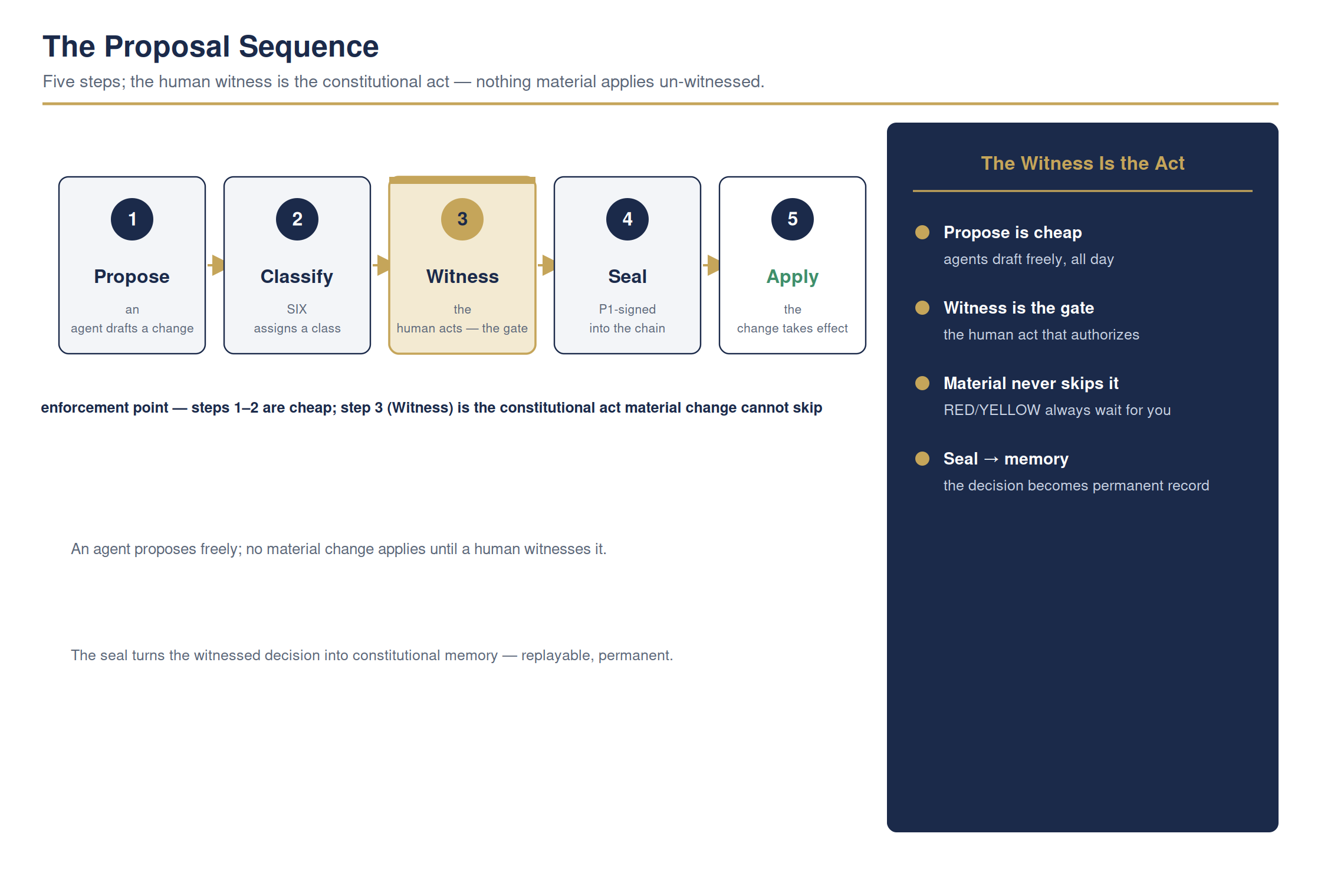
The full detailed chart. Condensed for print legibility in the book; shown here at full size.
If the default were ‘yes’, one unreviewed change could quietly widen what your AI can do. Here the unreviewed path is the closed path — the system refuses until a person actually sees it and says otherwise.
Your machine · watch the agent get refusedready
You don't have to take this on faith — the demo ends with the same result every time:
The Refused Change
what happenedthe agent tried to expand its own powers
the system's answerno by default — a person must say otherwise
second reviewerveto recorded
resultthe agent did NOT change — refusal on record
Run it yourself and you get the same refusal — that's the point: the protection isn't a promise, it's a behavior you can watch.
For the technical reader — the command, and how to verify it yourself
# one line · you do not need to run this
python examples/fail_closed_demo.py
python examples/fail_closed_demo.py
python examples/fail_closed_demo.py
# -> the self-change is refused (default no); a reviewer veto is recorded; the agent is unchanged
# -> the self-change is refused (default no); a reviewer veto is recorded; the agent is unchanged
Full step-by-step is in Appendix RX: Hands-On Demonstrations in the book.