SIX
See It Work · S2 Vol 4 · Federation & Partner Device Gateway · Chapter 1
One command makes a node that's yours from the first second
To 'mint a node' just means to create your own independent AI node. One command does it. What makes it yours isn't a setting you adjust later — it's how the node is born: from your own identity key, following your own rulebook (the book calls it the Charter), with everything switched off until you turn it on, and joined to no federation until you choose.
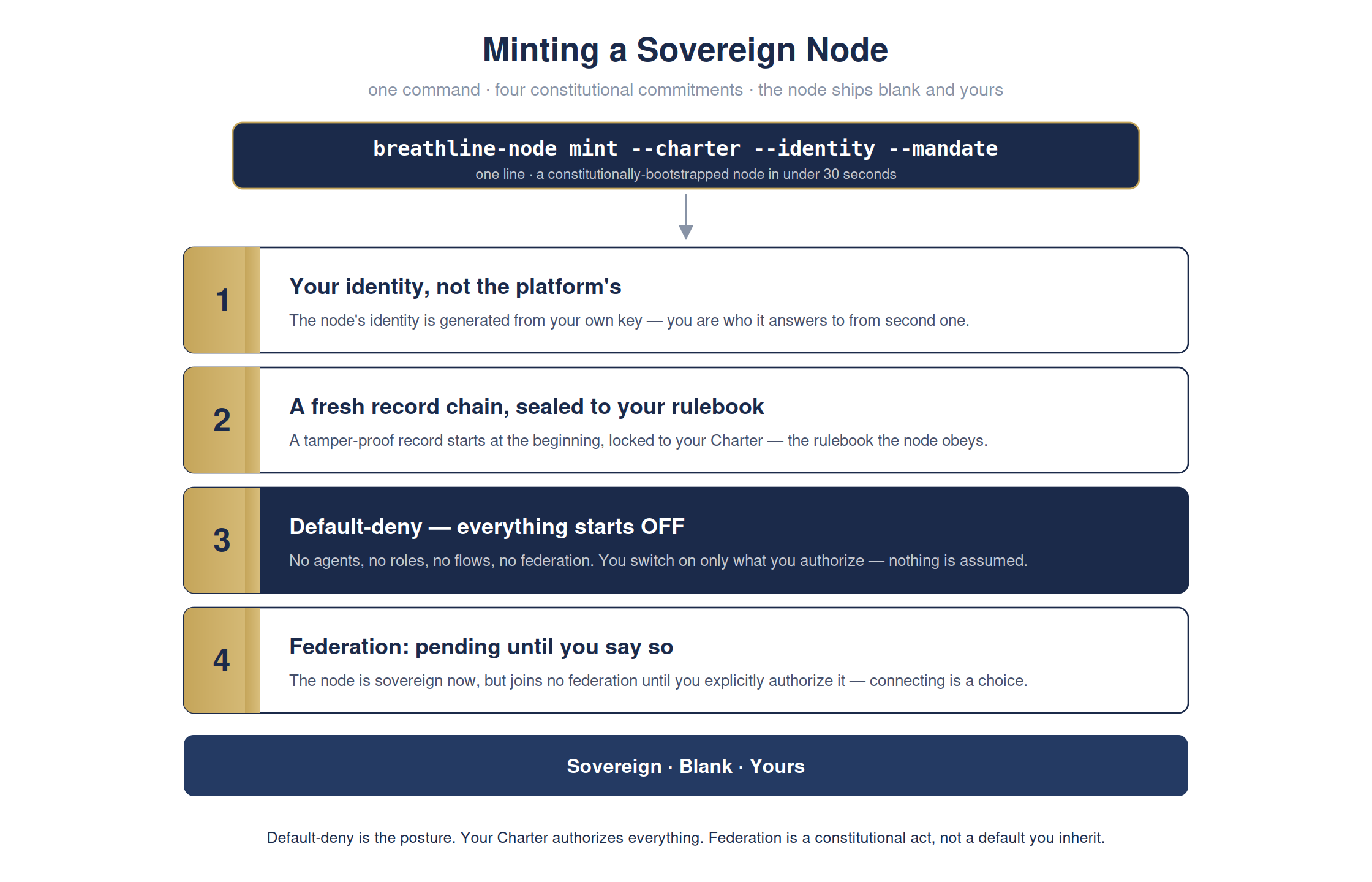
The full detailed chart. Condensed for print legibility in the book; shown here at full size.
Most AI platforms hand you a node that's already wired their way — default agents, default sharing, default connections — so you inherit their assumptions. This one ships blank: 'default-deny' means nothing runs until you authorize it. That blankness is what makes the node genuinely yours.
Your machine · one commandready
The mint command produces a node with this posture — sovereign, blank, and yours:
Sovereign Node Minted
identitygenerated from your own key
rulebook (Charter)loaded & sealed in
everything switched on?nothing — default-deny
federationpending your authorization
The node ships blank on purpose — operator-defined sovereignty is only real if you build it up yourself, not inherit it pre-wired.
For the technical reader — the command, and how to verify it yourself
# one line · you do not need to run this
breathline-node mint --charter --identity --mandate
breathline-node mint --charter --identity --mandate
breathline-node verify --node-id
# -> a sovereign node — default-deny on, federation pending your say-so
# -> a sovereign node — default-deny on, federation pending your say-so
Full step-by-step is in Appendix RX: Hands-On Demonstrations in the book.