SIX
See It Work · S2 Vol 4 · Federation & Partner Device Gateway · Chapter 10
New tenants start completely blank — and author their own rules
Running one platform for many tenants is the dominant scale pattern. The usual way ships defaults that tenants adopt — so they inherit the platform's assumptions. This ships blank: no default agents, roles, sharing, or connections. Each tenant authors its own rulebook, its records are walled off from other tenants, and it chooses whether to connect to anyone.
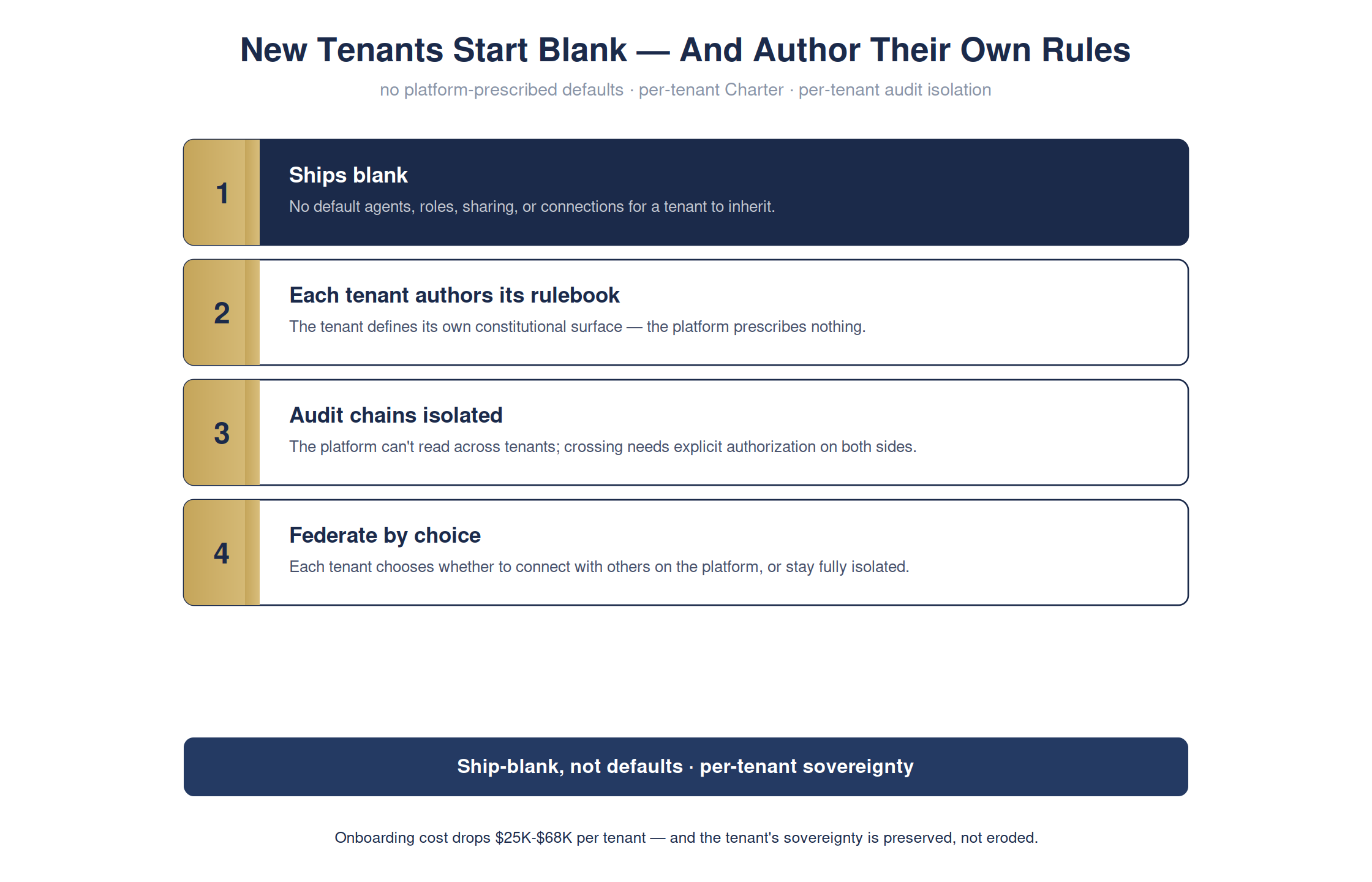
The full detailed chart. Condensed for print legibility in the book; shown here at full size.
Default-shipping erodes tenant sovereignty over time and costs $30K-$80K per onboarding in customization. Ship-blank preserves each tenant's sovereignty and drops onboarding to $5K-$12K — because there's nothing to customize away.
A platform · new tenant at zero-stateready
Each new tenant onboards at zero-state with its own sovereign surface:
Ship-Blank Tenant
defaults to inheritnone — ships blank
rulebookauthored by the tenant
recordswalled off per tenant
onboarding cost$5K-$12K vs $30K-$80K
Per-tenant savings $25K-$68K — and the tenant's sovereignty is preserved, not eroded.
For the technical reader — the command, and how to verify it yourself
# one line · you do not need to run this
open atrium-standalone.html
open atrium-standalone.html
./bl-verify
# -> a blank tenant under its own Charter, records isolated
# -> a blank tenant under its own Charter, records isolated
Full step-by-step is in Appendix RX: Hands-On Demonstrations in the book.