SIX
See It Work · S2 Vol 4 · Federation & Partner Device Gateway · Chapter 6
Staying aligned across nodes — by checking, not by being policed
Federation peers have to stay aligned over time or the federation falls apart. There's no central enforcer to make them. Instead, coherence is preserved three ways: each node verifies itself on its own schedule, the resonance receipts surface any drift between nodes, and a weekly cross-peer review catches divergence early.
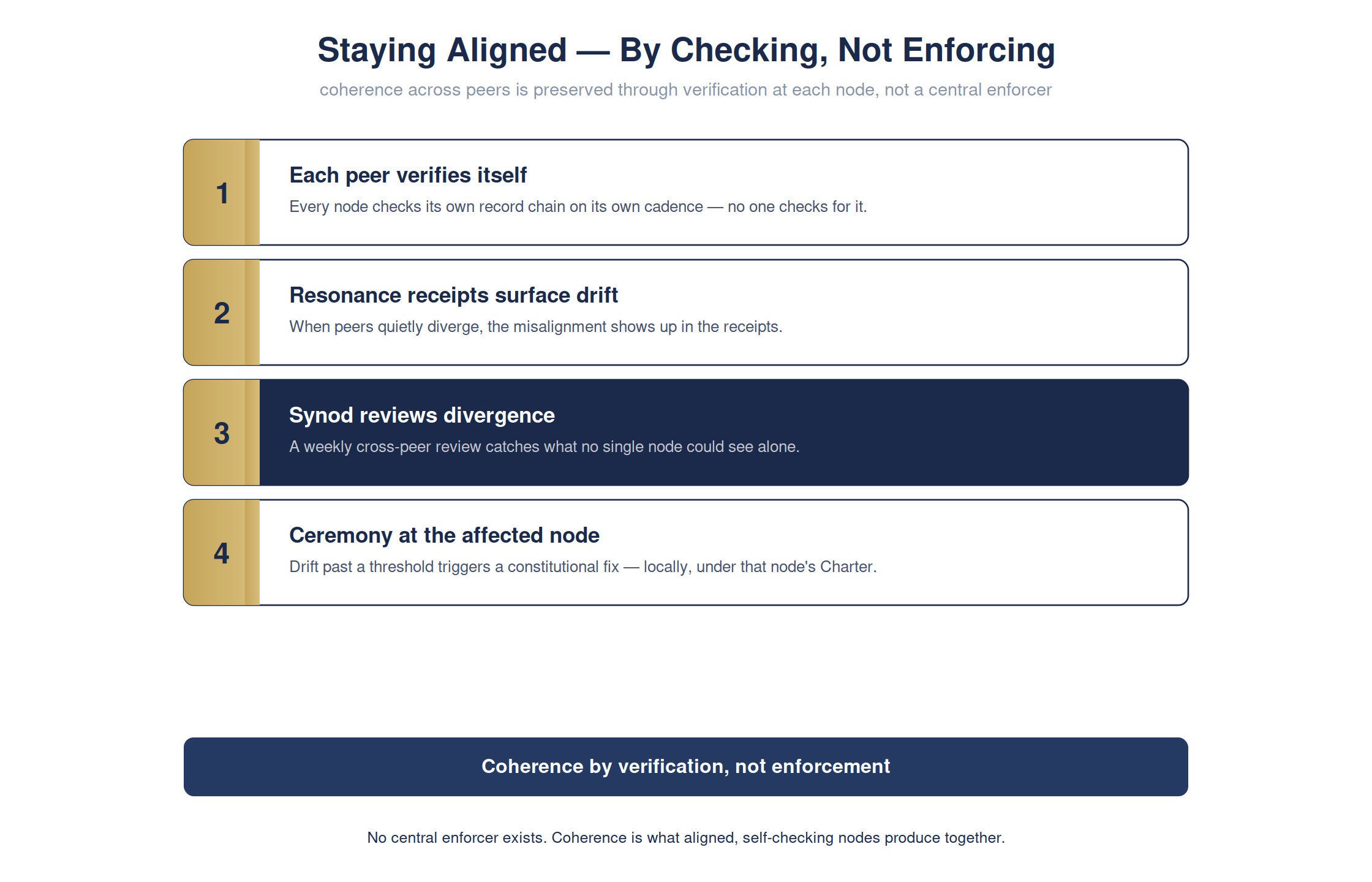
The full detailed chart. Condensed for print legibility in the book; shown here at full size.
Enforcement requires an enforcer — and the enforcer becomes the boss. Verification needs no boss: alignment is something each node confirms about itself, and drift simply shows up in the shared receipts.
Peers · weekly coherence reviewready
Coherence is preserved by three independent mechanisms — none of them central:
Coherence
each peerverifies its own chain
driftsurfaces in resonance receipts
weekly reviewcatches what one node can't
fixlocal ceremony, never imposed
No central enforcer — coherence is what aligned, self-checking nodes produce together.
For the technical reader — the command, and how to verify it yourself
# one line · you do not need to run this
see walkthrough
see walkthrough
./bl-verify
# -> coherence held by verification, not enforcement
# -> coherence held by verification, not enforcement
Full step-by-step is in Appendix RX: Hands-On Demonstrations in the book.