SIX
See It Work · S2 Vol 5 · Yield Organism & Generational Prosperity · Chapter 8
One signed bundle proves your numbers to any regulator
Today, proving yield to an auditor means weeks of gathering records and writing a narrative they have to trust. This replaces that with one signed bundle: your records, the proofs, and a small script. The auditor runs the script, it recomputes your yield from the receipts, and confirms it's true — independently of you. The same bundle maps to four regulatory regimes at once.
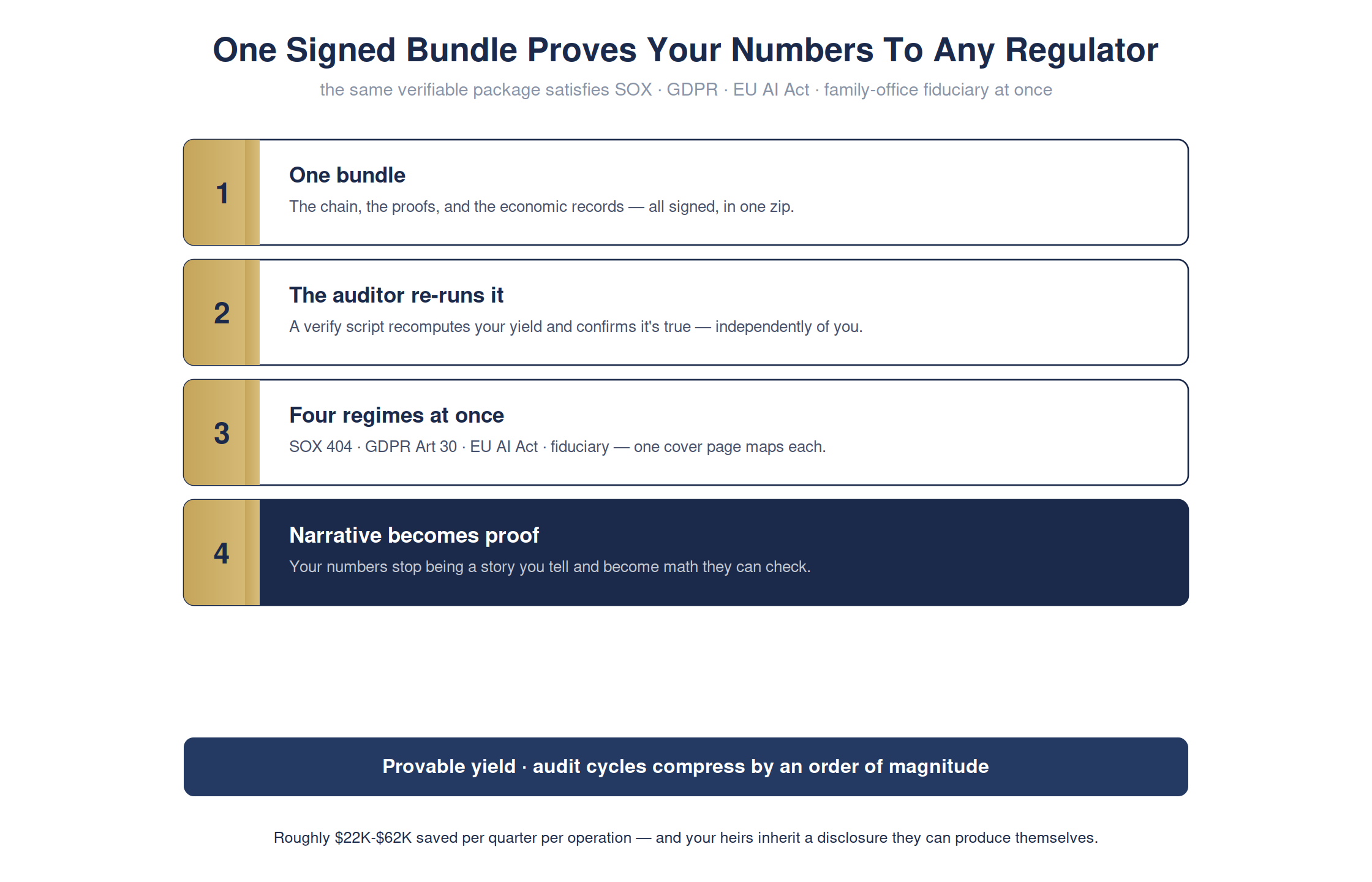
The full detailed chart. Condensed for print legibility in the book; shown here at full size.
This is the shift from narrative (you describe what happened; they trust the description) to proof (you hand over math they can check). Audit cycles compress from weeks to hours, and your heirs inherit a disclosure they can produce themselves.
Your auditor · one signed bundleready
One verifiable bundle the auditor re-runs — covering four regulatory frames at once:
Provable Yield
one signed bundlechain + proofs + economic records
the auditor re-runs itrecomputes your yield independently
coversSOX · GDPR · EU AI Act · fiduciary
prep timeweeks → ~2 hours
From narrative to cryptographic proof — the shift that makes your audit posture generational.
For the technical reader — the command, and how to verify it yourself
# one line · you do not need to run this
./bl-verify
./bl-verify
./bl-verify
# -> a signed bundle the auditor re-runs to confirm your yield
# -> a signed bundle the auditor re-runs to confirm your yield
Full step-by-step is in Appendix RX: Hands-On Demonstrations in the book.