The Capture Atlas — the United States as a training map
This is the United States drawn as a map of where value is collected by position — not a bill anyone can cash, and not an accusation. It is a training aid: the same lens you learned in the thirteen chapters, pointed at one country and footed number by number.
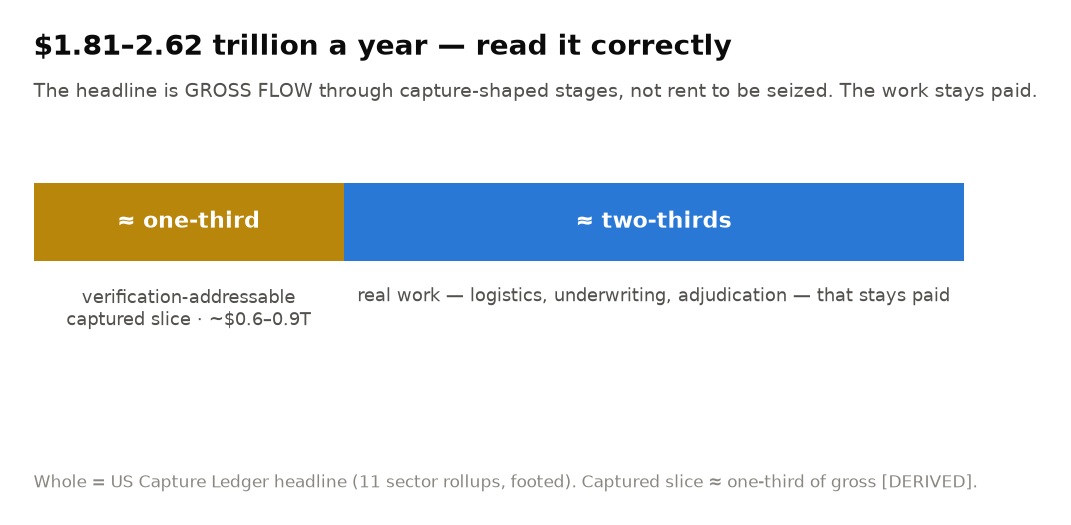
The one number, honestly read. $1.81–2.62 trillion a year of gross flow. About two-thirds is real work that stays paid; about a third is the verification-addressable captured slice. derived
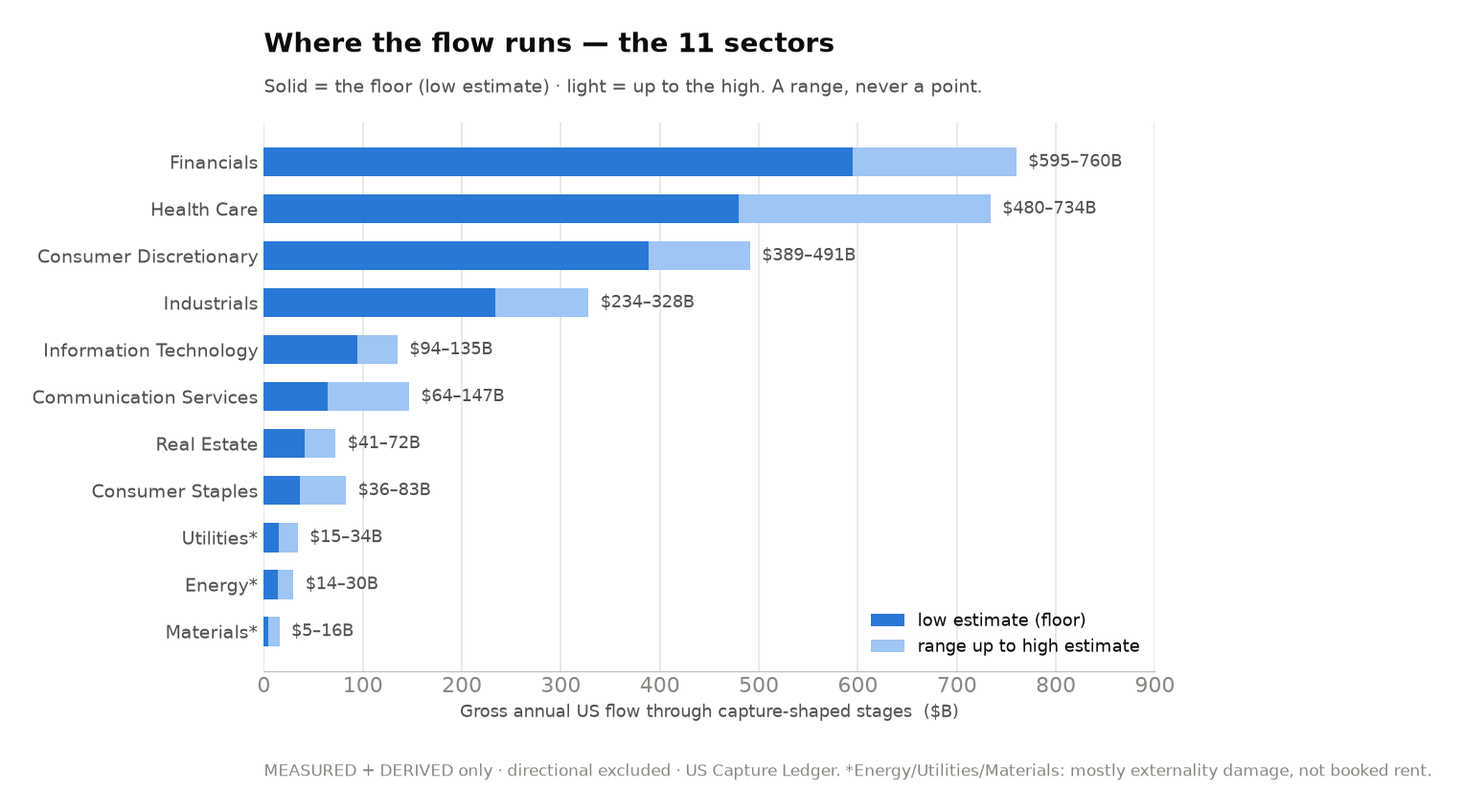
Every sector is a range, never a point. The solid bar is the floor (the low estimate); the light extension runs up to the high. Only measured and derived pieces are counted — the order-of-size guesses are left out. measuredderived
A big number is worthless unless you can rebuild it. Here it is, in public arithmetic: sum the eleven sectors, remove the five places the same dollar was counted twice, then carve out the damage that no stage actually books.
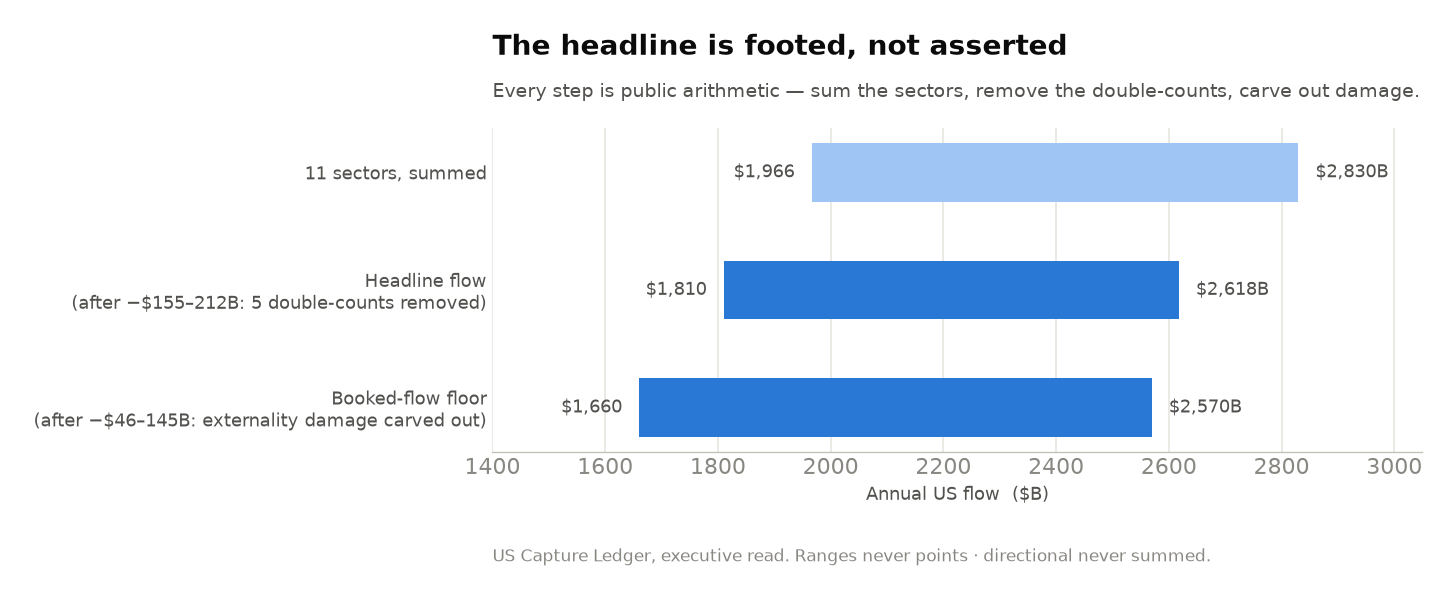
Sum, de-duplicate, carve. Eleven sectors add to $1,966–2,830B. Removing five cross-sector double-counts (−$155–212B) gives the $1.81–2.62T headline. Carving out externality damage (−$46–145B) leaves a booked-flow floor of $1.66–2.57T — the headline survives its own carve-out. measuredderived
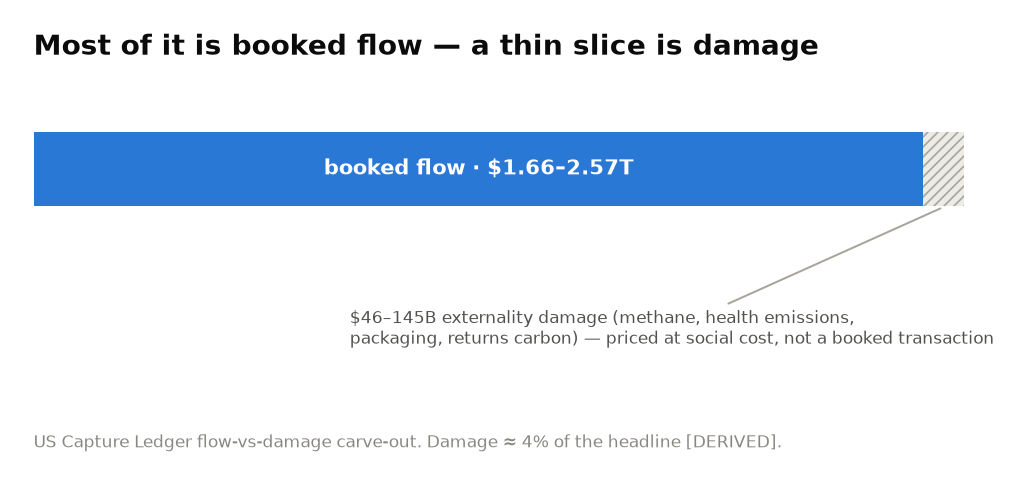
Flow versus damage. Most of the total is booked flow. A thin slice — about 4% — is externality damage (methane, health-sector emissions, packaging, returns carbon) priced at social cost, reported beside the flow and never hidden inside it. derived
Pick the most teachable sectors and open a single dollar in each. Every one is a measured breakdown — a regulator or federal series published it.
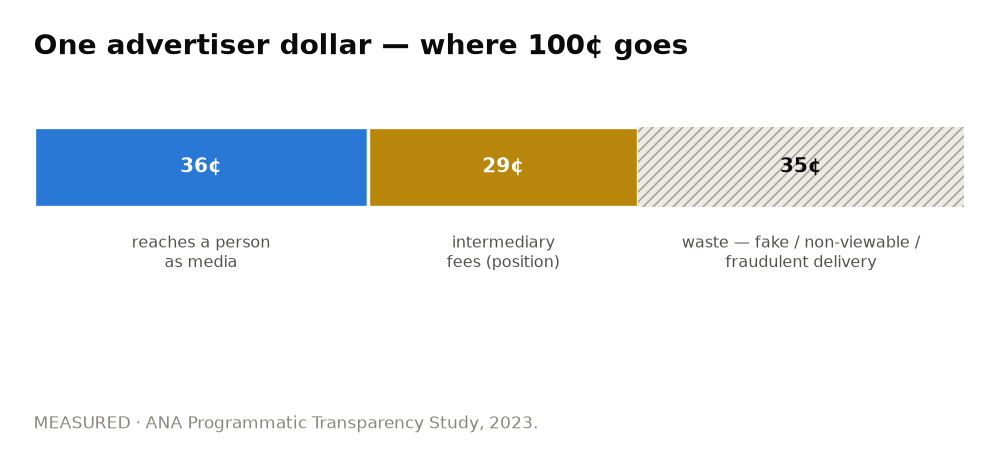
One advertiser dollar
Spend a dollar on an open-web ad and about 36¢ reaches a person as media. 29¢ is taken by the middle, and 35¢ vanishes into fake, unseen, or fraudulent delivery.
measured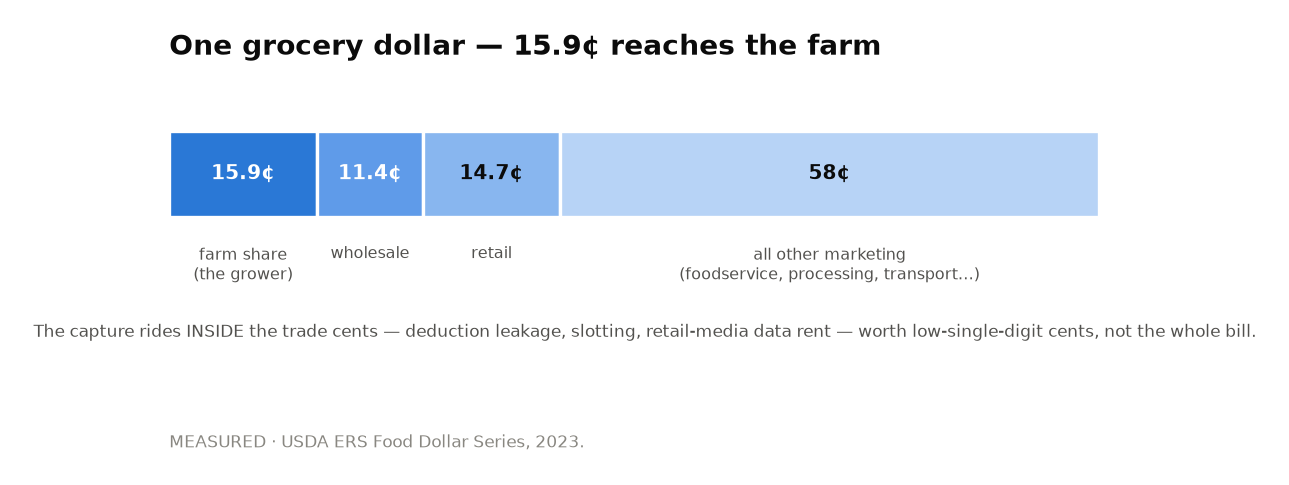
One grocery dollar
Of every dollar you spend on food, 15.9¢ reaches the farm that grew it. The rest is the marketing bill — most of it real work, with the capture riding thin inside the trade cents.
measured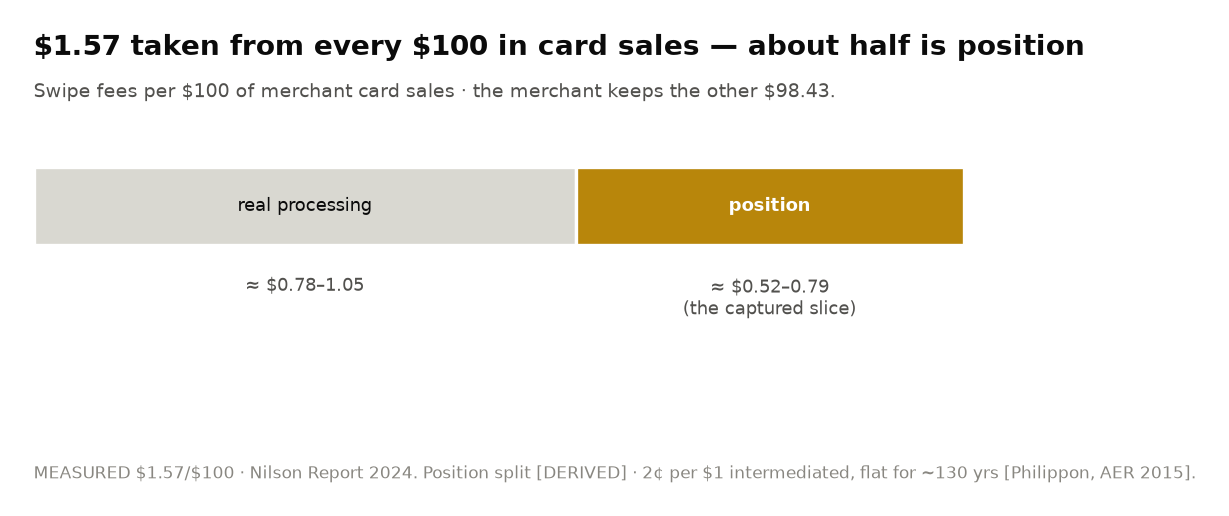
The card across the counter
Of every $100 in card sales, $1.57 is taken before the merchant sees a cent — and about half of that is position, not the cost of doing the work. The 2¢-per-dollar cost of finance hasn't fallen in 130 years.
measured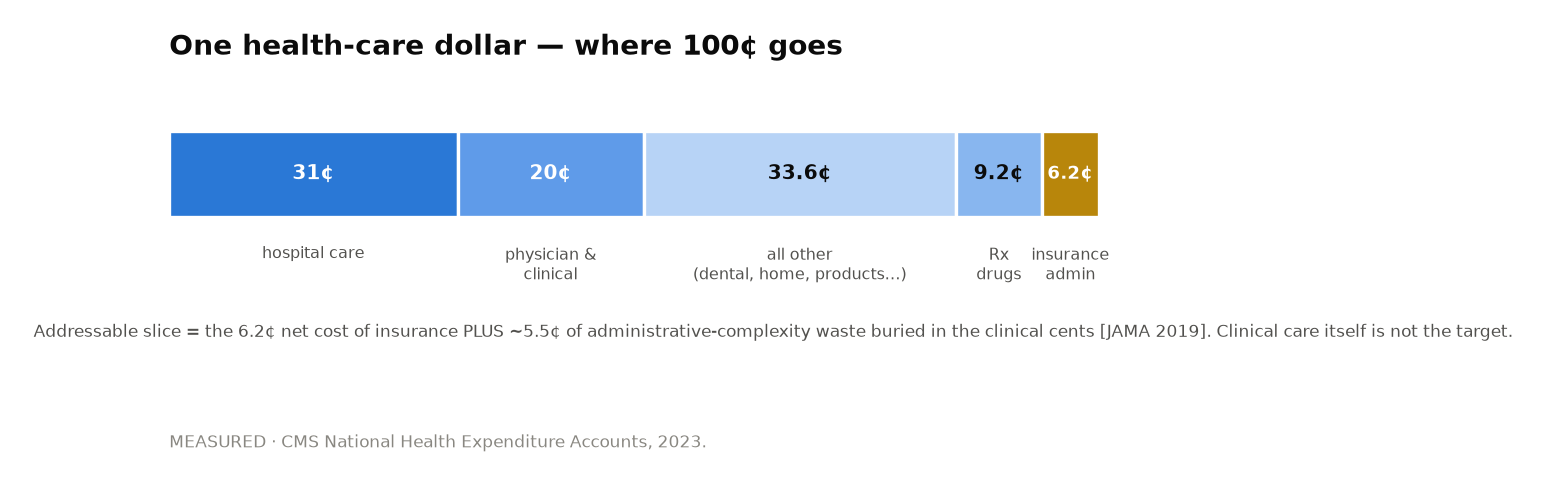
One health-care dollar
Hospitals and physicians do the care. The addressable slice is the 6.2¢ net cost of insurance plus roughly 5.5¢ of paperwork-complexity waste buried in the clinical cents — not the care itself.
measuredThis page is the training map. The full research documents are free — the complete US Capture Atlas and the priced Capture Ledger, every component graded with its named source.