SIX
See It Work · S2 Vol 1 · Sovereign Inference & Memory · Chapter 1
Four things you should be able to prove about your AI — but can't
Say your AI produced a number — a forecast, a decision. Four fair questions: Did this actually run? On what input? Was sensitive data handled correctly? Who authorized it? On a typical cloud AI service (you rent the AI from a big vendor over the internet), the honest answer to all four is: you can't prove it on your own — you can only take the vendor's word.
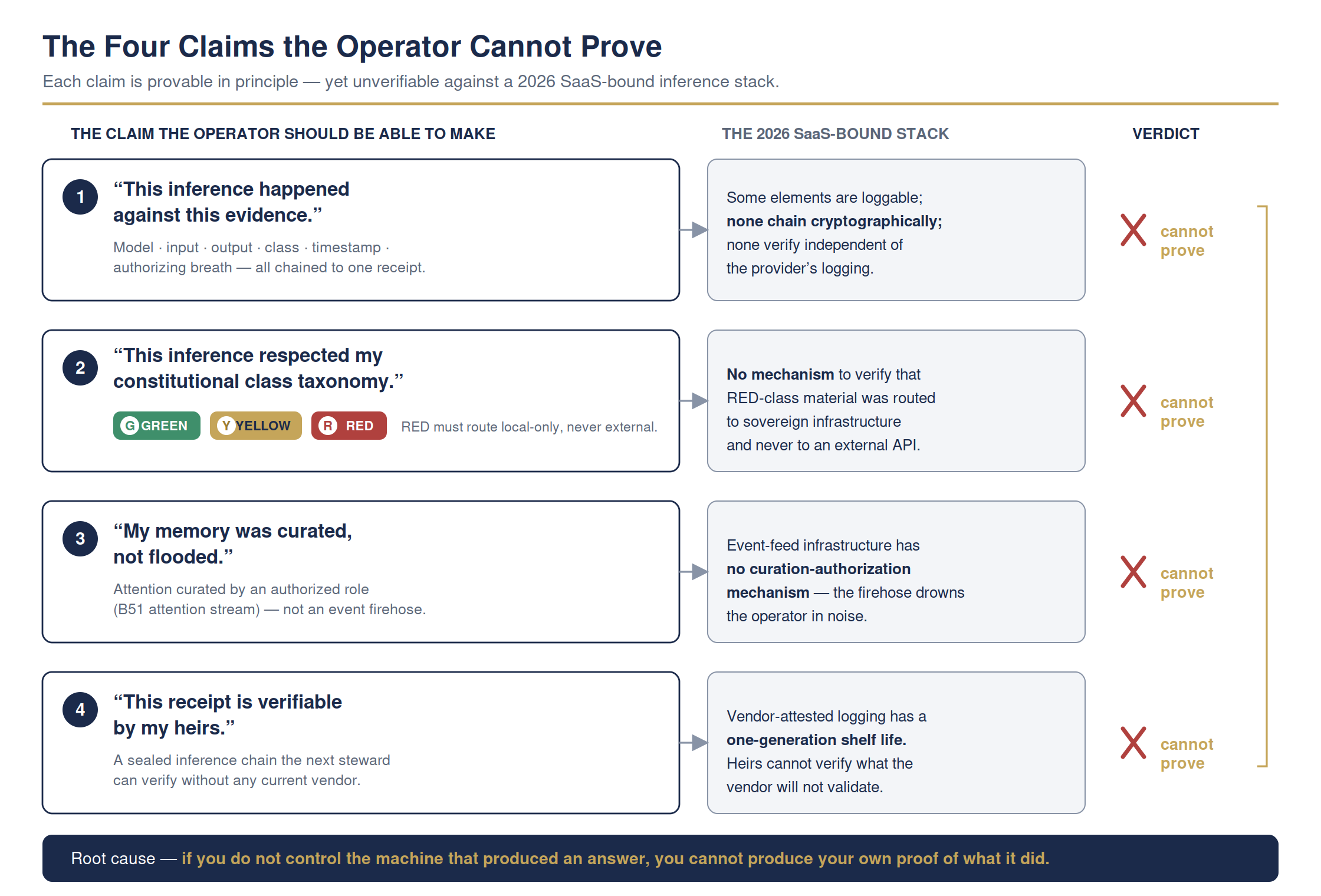
The full detailed chart. Condensed for print legibility in the book; shown here at full size.
That's the whole problem. If you don't control the machine that produced an answer, you can't produce your own proof of what it did — you're trusting a company's word. A receipt (a tamper-proof record the AI makes for every action) is what closes that gap.
The audit you can't pass — yetready
Here's the gap made concrete — the four questions, and today's honest verdict on each:
The Four Claims
this AI work actually happenedcannot prove
sensitive data was handled rightcannot prove
my memory was curated, not floodedcannot prove
verdict on rented cloud AIcannot prove
Every chapter that follows turns one of these from 'cannot prove' into a receipt you run yourself.
For the technical reader — the command, and how to verify it yourself
# one line · you do not need to run this
see walkthrough
see walkthrough
./bl-verify
# -> the foundation that makes the four questions provable
# -> the foundation that makes the four questions provable
Full step-by-step is in Appendix RX: Hands-On Demonstrations in the book.