SIX
See It Work · S2 Vol 2 · The Primacy Cockpit · Chapter 9
Catch the slow drift before a boundary quietly moves
The dangerous change isn't a sudden break — it's slow drift, where a boundary moves a little at a time until one day it's somewhere you never agreed to. The cockpit catches it three ways: a running drift indicator, a regular review cadence (the book calls it the Synod), and a register of small accumulating gaps.
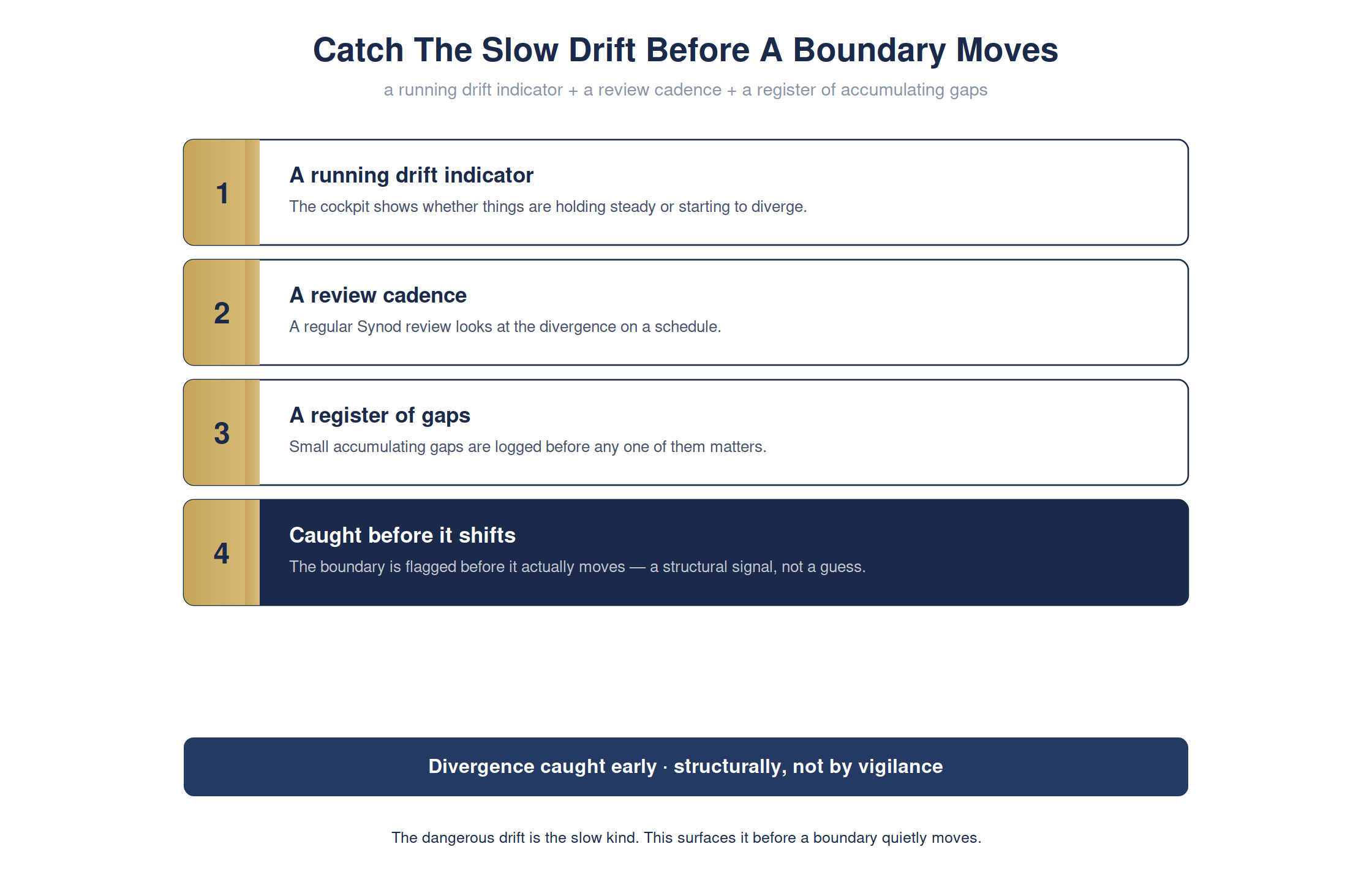
The full detailed chart. Condensed for print legibility in the book; shown here at full size.
By the time slow drift is obvious, the boundary has already moved. Surfacing it early — as a structural signal, not a guess — is what lets you correct course before anything important quietly shifts.
The cockpit · drift surfaceready
Three mechanisms catch divergence before the boundary shifts:
Drift Surface
running indicatorholding or diverging?
review cadencedivergence checked on schedule
gap registersmall gaps logged early
resultcaught before the boundary moves
Divergence caught structurally, not by vigilance — the slow drift surfaces before it lands.
For the technical reader — the command, and how to verify it yourself
# one line · you do not need to run this
open atrium-standalone.html
open atrium-standalone.html
open atrium-standalone.html
# -> drift surfaced early via indicator + review + gap register
# -> drift surfaced early via indicator + review + gap register
Full step-by-step is in Appendix RX: Hands-On Demonstrations in the book.