SIX
See It Work · S2 Vol 4 · Federation & Partner Device Gateway · Chapter 3
How news travels between nodes — with no central server
When a constitutional event happens at one node — say a rule change — the others should know. A sealed, signed update (the book calls it a shard) travels peer-to-peer. Crucially, it carries the fact that something happened, not your underlying data. Every node that receives it runs the same four-step check: verify → diff → classify → decide.
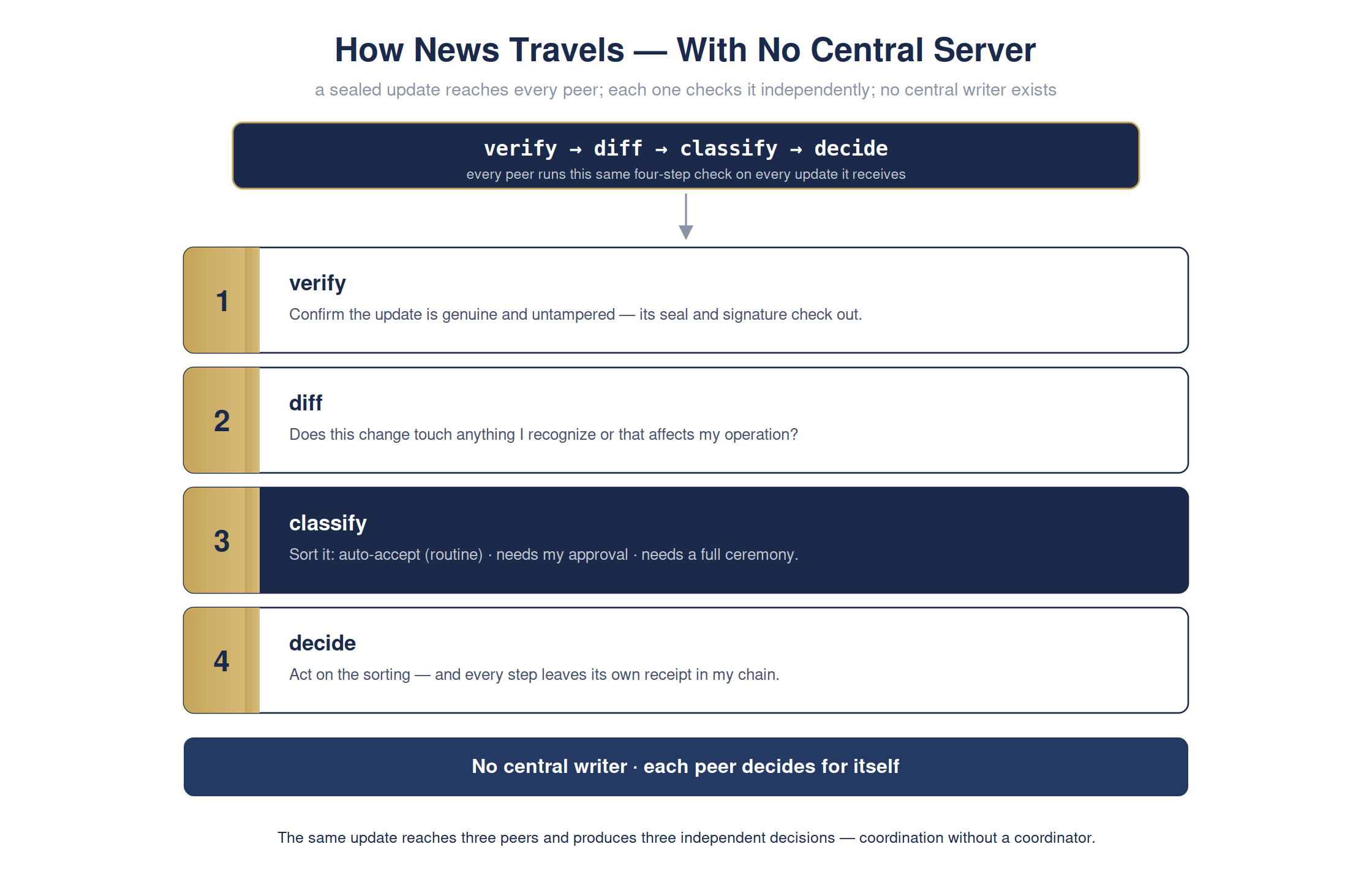
The full detailed chart. Condensed for print legibility in the book; shown here at full size.
Most 'federated' systems have a hidden central writer — a coordinator that, over time, becomes the boss. Here there is none: each node checks each update itself, so no single point can capture the network or take it down.
Three peers · one updateready
Each peer runs the same four-step check and seals a receipt at every step:
Update Received
verifygenuine & untampered
diffdoes it affect me?
classifyroutine / approve / ceremony
decide + receiptmy own call, recorded
The same update produced different decisions at each peer — apparent coordination, zero central control.
For the technical reader — the command, and how to verify it yourself
# one line · you do not need to run this
see walkthrough
see walkthrough
./bl-verify --check-anchor
# -> a sealed update each peer verifies independently
# -> a sealed update each peer verifies independently
Full step-by-step is in Appendix RX: Hands-On Demonstrations in the book.