SIX
See It Work · S2 Vol 5 · Yield Organism & Generational Prosperity · Chapter 7
Where attacks can land — and where they simply can't
Every yield system attracts attackers in proportion to the value it moves. The honest move is to name where they can and can't land. Allocation capture is impossible — there's no central allocator. Compounding manipulation is limited — growth is capped, the base is the receipt chain, and you can't extract from a not-yet-sealed future. Per-event forgery stays real — and is defended.
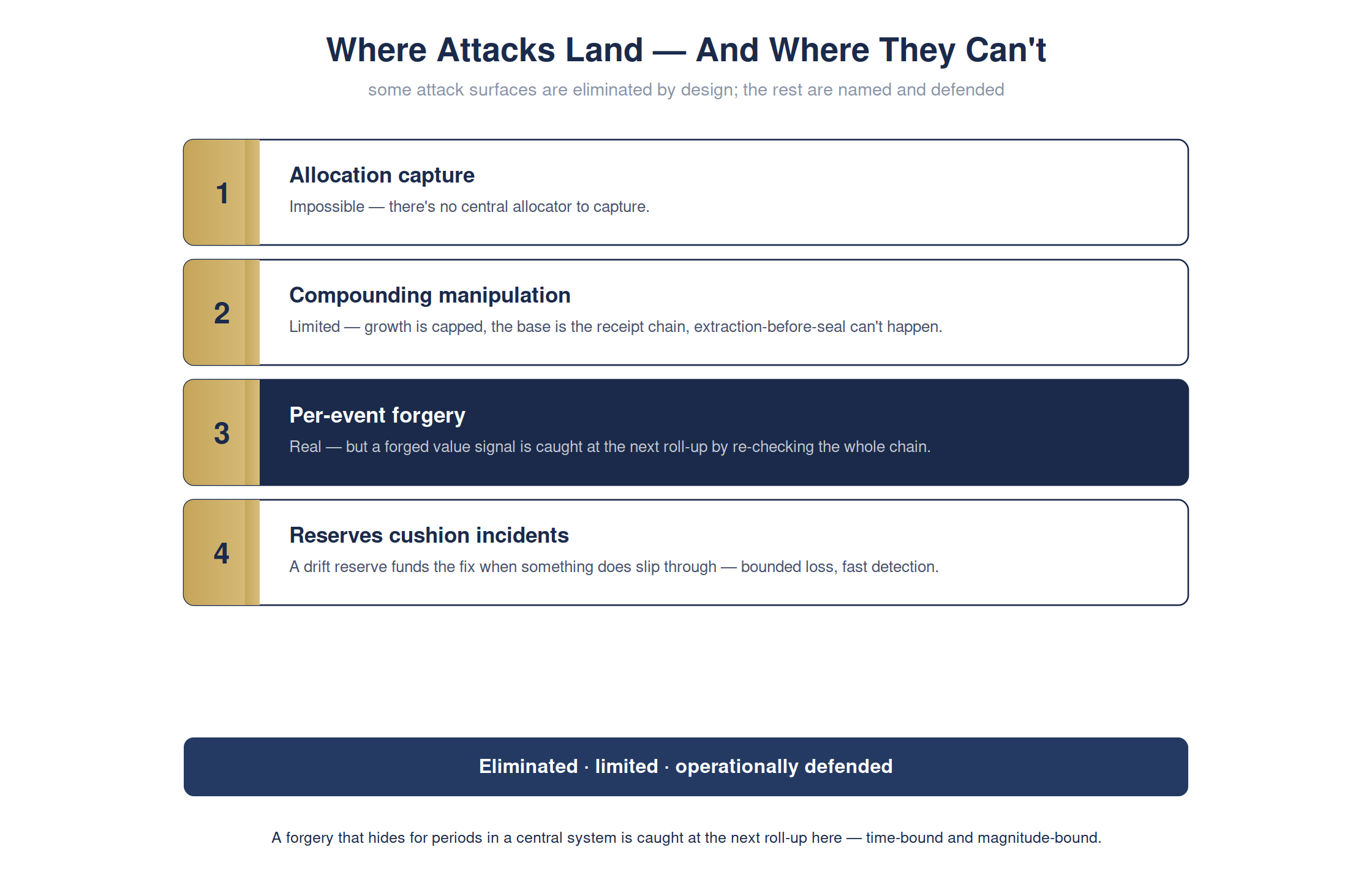
The full detailed chart. Condensed for print legibility in the book; shown here at full size.
A forged value record in a central system can hide for periods, quietly accumulating before anyone notices. Here, the whole chain is re-checked at the next roll-up — so a forgery is caught within a day or a week, and the loss is capped per event.
Red team · a forged value signalready
The threat model is explicit — eliminated, limited, and operationally defended:
Threat Model
allocation captureimpossible — no allocator
compounding manipulationlimited — capped + receipt-based
per-event forgerycaught at the next roll-up
incidentsreserve funds the fix
Time-bound detection + magnitude-bound loss + audit-chain preserved — materially stronger than central alternatives.
For the technical reader — the command, and how to verify it yourself
# one line · you do not need to run this
see walkthrough
see walkthrough
./bl-verify
# -> a forged value signal caught at the next roll-up
# -> a forged value signal caught at the next roll-up
Full step-by-step is in Appendix RX: Hands-On Demonstrations in the book.