SIX
See It Work · S3 Vol 3 · Helix · Appendix A
The whole protocol, small enough to read on a few pages
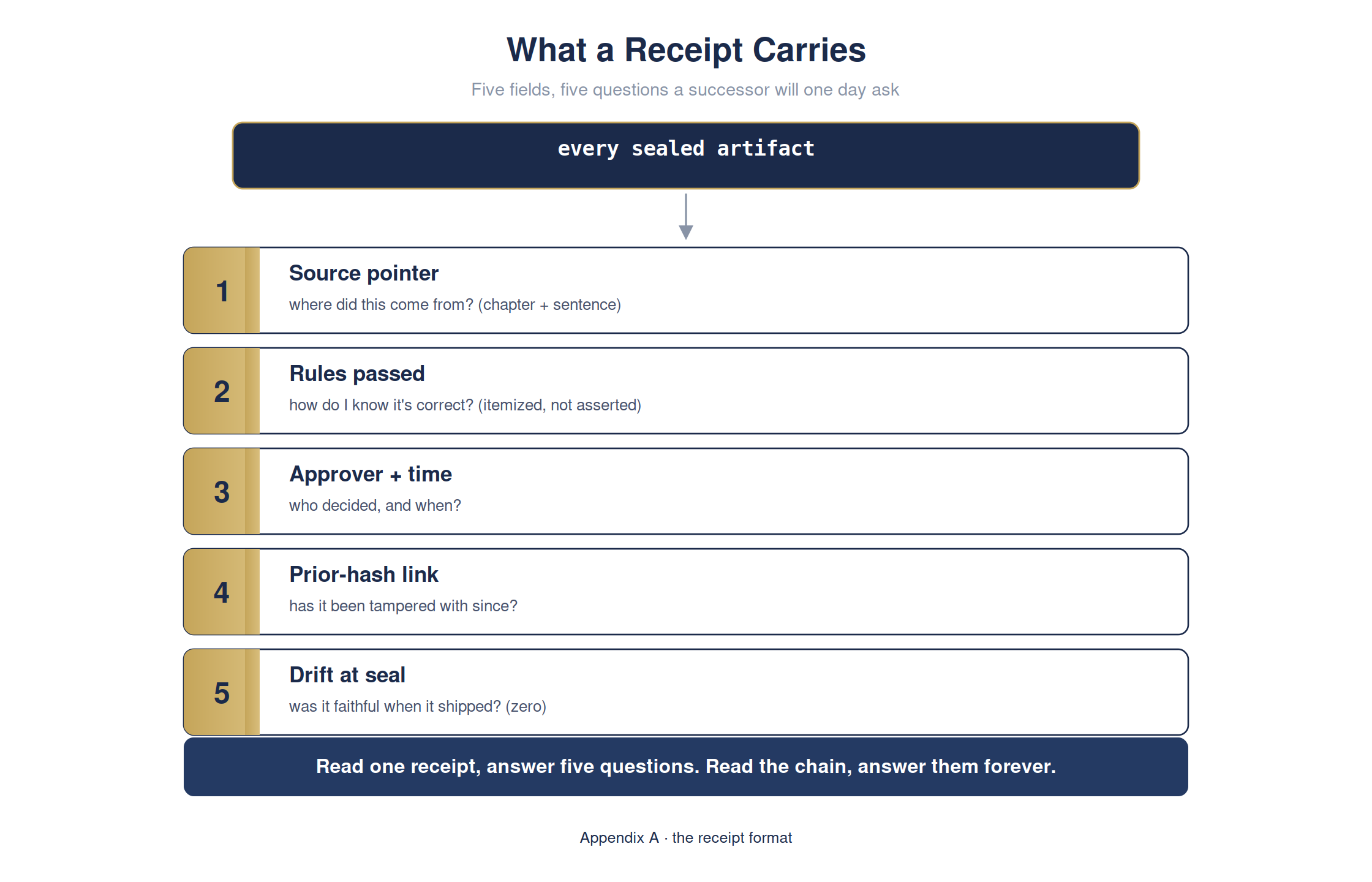
Helix is a small set of single-purpose services. The boot order is a rule: guards before render. Every artifact passes seven validation rules (A through G). Every shipped artifact carries a five-field receipt. That is the whole engine — readable on a handful of pages.
The full detailed chart. Condensed for print legibility in the book; shown here at full size.
Notice what is deliberately absent: no plugin marketplace, no scripting layer that reaches outside declared authority, no "advanced mode" that bypasses the gates. Every one of those would be a door, and every door is a place trust leaks out. Smallness is the feature that makes the whole thing inheritable.
What's left out, on purposeready
Here's the whole engine, compactly:
The protocol, in full
servicesfew, single-purpose, declared
boot orderguards before render
rulesA-G, every artifact, mechanical
deliberately absentno bypass, no hidden doors
A protocol you can read is a protocol an heir can audit.
For the technical reader — the command, and how to verify it yourself
# one line · you do not need to run this
see walkthrough
see walkthrough
HELIX_SERVICES.yaml + HELIX_BOOT.yaml
# -> the whole engine, small enough to fully understand
# -> the whole engine, small enough to fully understand
Full step-by-step is in Appendix RX: Hands-On Demonstrations in the book.