SIX
See It Work · S3 Vol 3 · Helix · Chapter 2
The boring protocol that makes "it generated some code" trustworthy
Helix is a small set of single-purpose services declared in two plain files you can read on one screen. The order they start in is itself a rule: the validation guards come up before any render is allowed to run. The system refuses to render until they are ready.
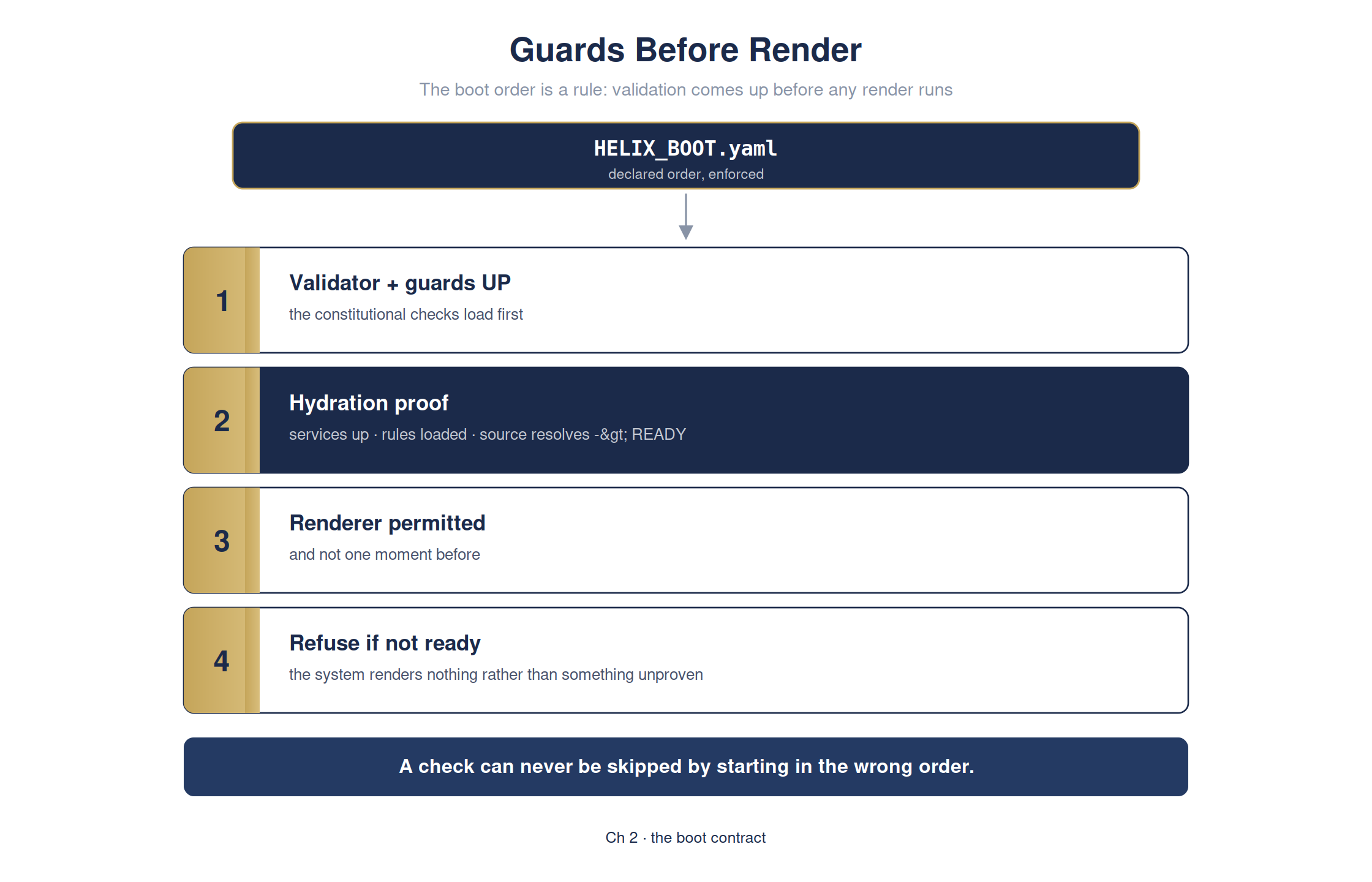
The full detailed chart. Condensed for print legibility in the book; shown here at full size.
This is why "deterministic" is more than a buzzword. A check that runs after something ships is an apology; a check that runs before is a refusal — and only the refusal protects anyone. The boot produces a hydration proof: evidence it is ready, not just an announcement.
The boot that refuses to startready
Here's the boot contract — readiness proven, not assumed:
The hydration proof
validation guardsup before any render
validation rules loadedyes
source resolves to real contentyes
render permittedonly now
Readiness is a thing the protocol proves, not a thing it claims.
For the technical reader — the command, and how to verify it yourself
# one line · you do not need to run this
see walkthrough
see walkthrough
HELIX_BOOT.yaml (guards-before-render)
# -> a boot that refuses to render until the guards are standing
# -> a boot that refuses to render until the guards are standing
Full step-by-step is in Appendix RX: Hands-On Demonstrations in the book.