SIX
See It Work · S3 Vol 3 · Helix · Chapter 3
Watch a paragraph become real software — with a receipt
The path has five steps: a chapter becomes a spec, the spec defines a role (a least-authority job), the role renders an artifact (the working piece), the artifact is validated against the rules, and the validation seals a receipt. Each step is a function of the one before it — so the same chapter always yields the same software.
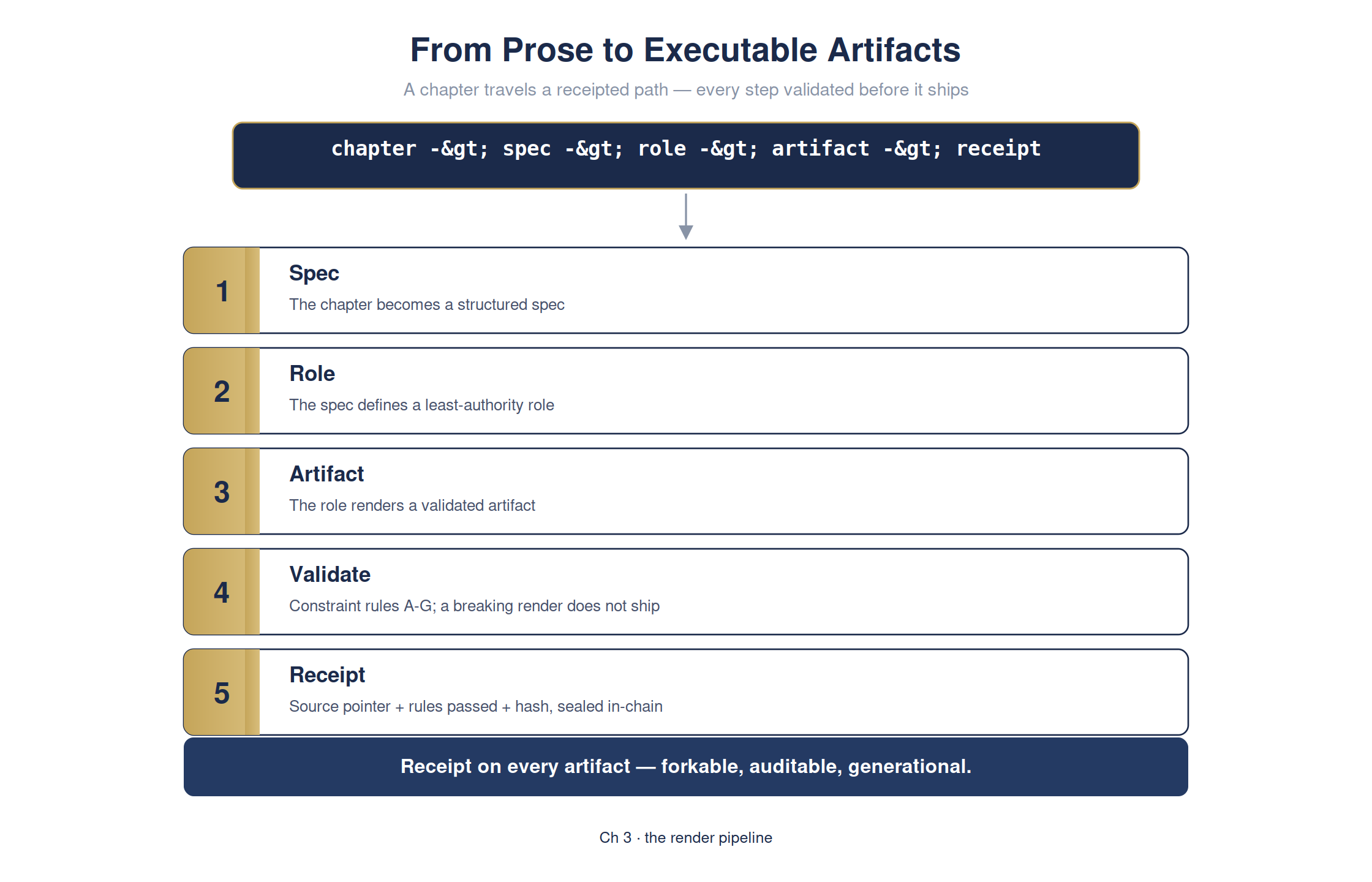
The full detailed chart. Condensed for print legibility in the book; shown here at full size.
An artifact without a receipt is back to the documentation lie: it claims to be faithful with no way to check. So every rendered piece carries its source, the rules it passed, and a hash that ties it to the chain — forkable, auditable property your successors can trust.
The grammar that bitesready
Here's the constraint biting — a real render blocked at commit on this book:
A bad render, refused
the rendera manuscript chapter, at commit
rule that caught itprint-unsafe character
outcomecommit BLOCKED until fixed
after the fix0 violations, shipped
The grammar is real: it stopped this book from shipping a flawed render until the source was corrected.
For the technical reader — the command, and how to verify it yourself
# one line · you do not need to run this
see walkthrough
see walkthrough
chapter -> spec -> artifact -> receipt
# -> a receipt on every rendered piece
# -> a receipt on every rendered piece
Full step-by-step is in Appendix RX: Hands-On Demonstrations in the book.